Letters toParadisePart Two
A story by RayHope
Letters to Paradise
Opening the book
A story by RayHope
Letters to Paradise
A story by RayHope
Part Two · A World Beyond the Impossible

Love can cross the boundaries of worlds,
survive the silence of forgotten memories,
and search for someone
even when the universe itself stands in the way.
RayHope
Before the first page

Part Two
Letters to Paradise
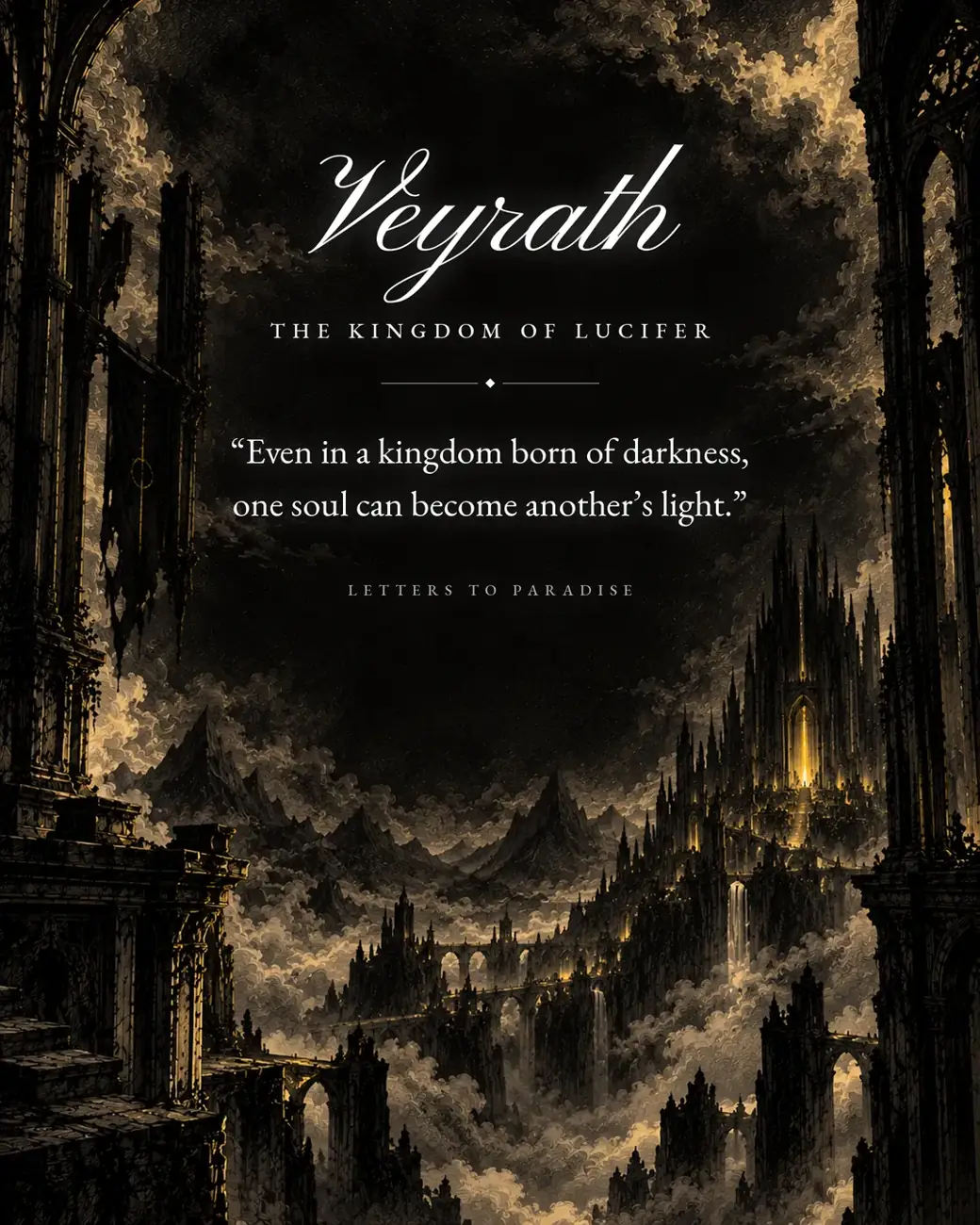
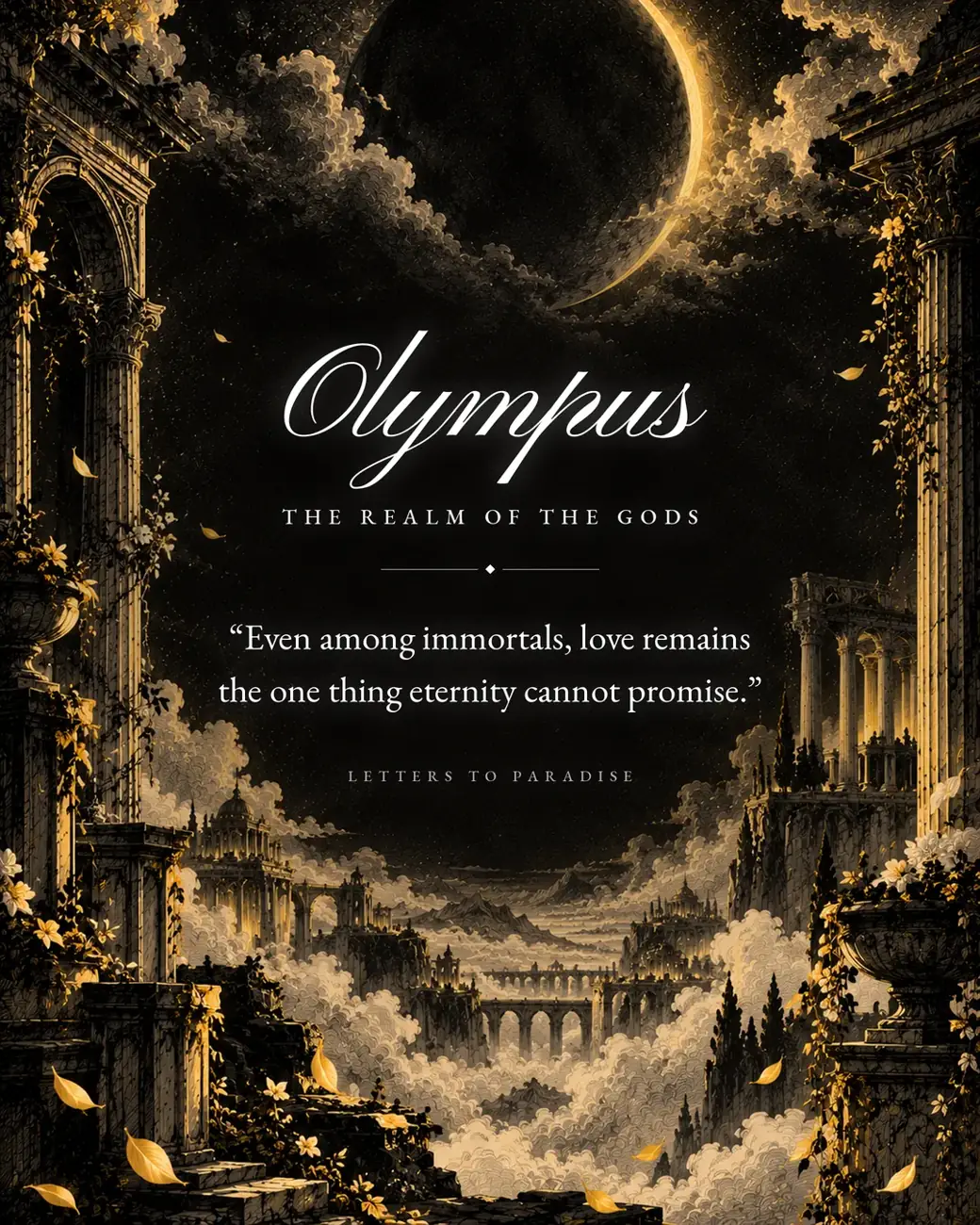
Veyrath · Olympus
Somewhere beyond the stars we know, the search continues.
Beyond the reach of science, beyond the borders of reality, there may be worlds where myths breathe, gods walk among mortals, and nightmares wear crowns. Worlds where the impossible is ordinary, where a fallen angel can command the sky, and where a single name can make kingdoms tremble.
Perhaps fantasy is only reality we have not yet discovered.
Perhaps the gods are not as distant as we believe.
And perhaps, in a universe where everything we know can be questioned, one truth remains untouched.
It can cross the boundaries of worlds, survive the silence of forgotten memories, and search for someone even when the universe itself stands in the way.
But what happens when the man you love disappears inside a god?
What happens when the heart that once dreamed of building Paradise becomes the heart of the King of the Dark?
The search continues.
And somewhere beyond the known universe, a forgotten man is about to discover the terrible beauty of becoming everything he once wished to be.
The first thing he heard was the sound of something burning.
Not the crackle of a small fire, but the hungry roar of flames devouring everything they could reach. Smoke filled his lungs. Iron and wet earth clung to the air. He tried to move, and pain opened inside his chest.
When he opened his eyes, the sky was red.
A battlefield stretched beneath it. Broken weapons lay in the mud. Dark banners snapped in the wind. Men in unfamiliar armour moved among the fallen, and beyond them a fortress rose from black stone.
He tried to sit up. Something heavy dragged behind him.
Two enormous wings lay crumpled against the ground.
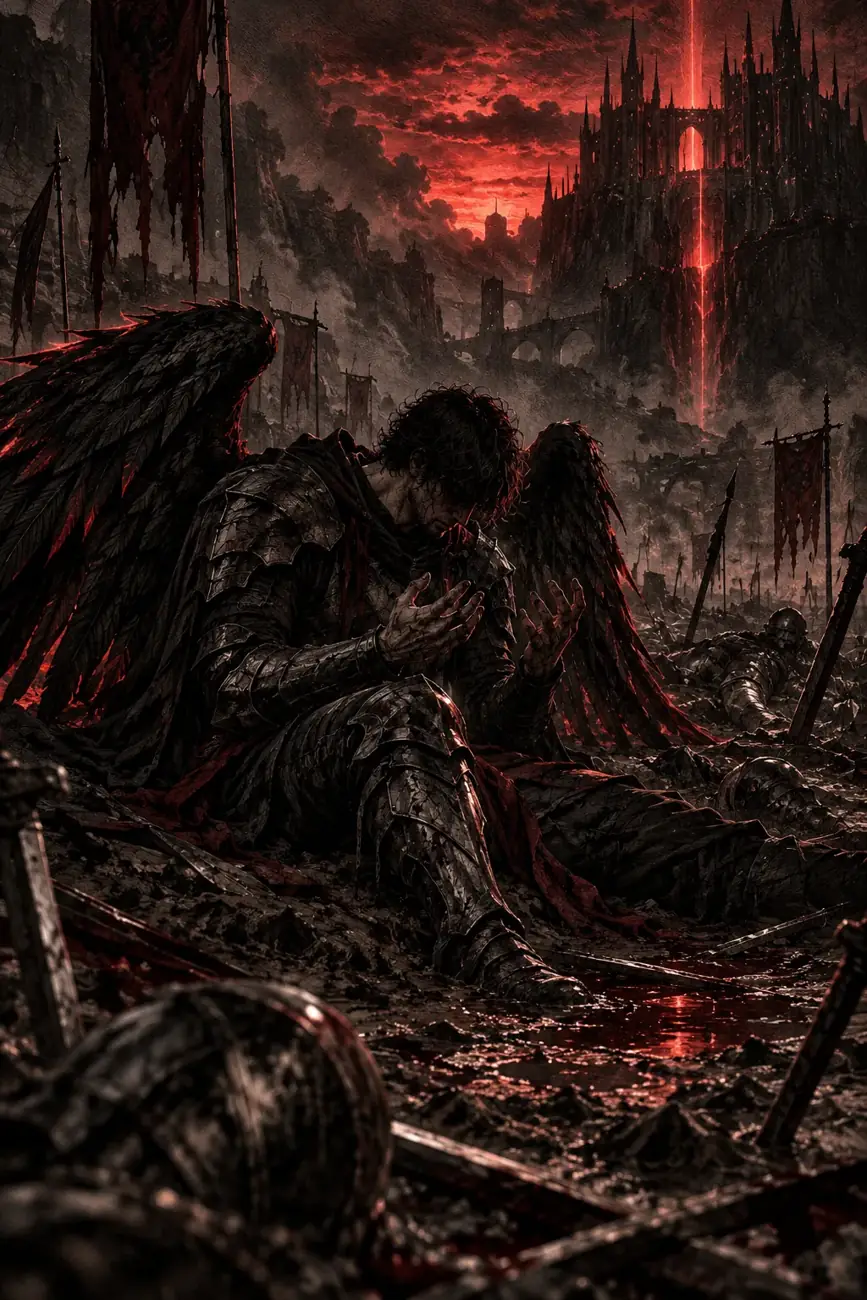
He touched the feathers. They moved.
For several seconds he could only stare. Then he looked at his hands, at the scars across his knuckles, at the unfamiliar armour fastened around his forearms. He searched for a memory and found fragments: white lights, glass and steel, voices calling his name.
Ray.
He held on to the name. A second came after it, certain and cold.
Lucifer.
A rider approached through the smoke, saw him, and dropped to his knees.
“My lord.”
“Where am I?”
“The Black Guard’s eastern line, my lord. The battle is being fought on the Cinder Flats, just beyond the old watchtowers.”
The rider spoke as though the place should mean something to him. When Ray only stared, the man glanced towards the broken standards and the smoke-covered ridge. “The rebels broke through the ravine before dawn. We have been trying to hold the eastern line ever since.”
He hesitated, studying Ray’s face beneath the streaks of ash. “You do not remember?”
Ray searched the rider’s expression for a hint that this was a test, a joke, or some cruel performance staged around him. He found none. The man’s fear was too genuine, and the battlefield beyond him too real.
“I don’t remember anything,” Ray said. The words came out rough, dragged across a throat that felt scraped raw. “Not the battle. Not this place. Not you.”
The rider’s hand tightened around the reins. Behind him, two soldiers exchanged a glance and quickly looked away. Ray saw the movement. Whatever they believed about the man whose body he occupied, they had not expected him to say this.
“Fetch the captain,” the rider ordered one of them. “Tell Caelan Voss that his lord is awake.”
The soldier ran towards the ridge, slipping once in the mud before catching himself. The rider remained where he was, uncertain whether to help Ray stand or keep his distance.
Ray looked again at the black standards. Their cloth bore a pale emblem, a circle split by a jagged line. The symbol meant nothing to him, but the men around him treated it as if it could decide who lived and who died.
Cinder Flats. Black Guard. Rebels. The words were pieces without a picture. Ray repeated them silently, trying to make them connect to the fragments inside his head. Nothing answered.
He looked down at his hands again. The scars, the blood, the unfamiliar strength in his fingers all belonged to a life he could not reach. He had no way to know whether he had been a soldier, a prisoner, or the person who had brought this battle upon them.
“Did I do this?” he asked.
The rider did not answer quickly enough.
Ray turned towards the burning wagons. “That is answer enough.”
A horn sounded from the eastern line. The rider twisted towards it. On the ridge, a black banner dipped, vanished behind a wall of smoke, and rose again. A wave of enemy soldiers was advancing through the breach, their shields locked together. The battle had not ended. It was moving towards them.
“We have to get you away from here,” the rider said.
Ray pushed himself upright.
His legs held him without hesitation.
He stood easily, without the careful calculation that had governed his movements for most of his life. For a moment, he did not understand what had happened. He waited for the old uncertainty, for the familiar need to measure each movement and prepare for the possibility of falling.
Nothing came.
He took one step. Then another. His balance followed him perfectly. He crossed the uneven ground, stepped over a broken spear, and climbed the low ridge without reaching for support.
He stopped at the top and looked down at his feet.
“I can walk,” he whispered.
The rider looked at him, confused by the wonder in his voice.
Ray tried again, walking faster this time. He moved across the ridge, then broke into a run. His body carried him with effortless strength. The wind struck his face. He laughed, breathless and almost disbelieving, and ran until the joy became too large to keep inside him.
He did not know why the discovery mattered so much. He could not remember the years of frustration or the quiet adjustments that had shaped another life. But his body remembered something his mind had lost. The freedom felt like a door opening inside him.
He looked towards the battlefield. “What else can this body do?”
Only then did he feel the wings properly. They shifted behind his shoulders, enormous and alive, their dark feathers scraping against the armour at his back.
He turned and stared at them. “Can I control these?”
“My lord,” the rider said, “I would advise you not to...”
Ray jumped.
For one terrible instant, he fell. The ground rushed towards him, and instinct told him he had made a foolish mistake. Then his wings opened. The air caught beneath them with a force that lifted his chest and flung him forward.
He rose above the ridge.
The cry that escaped him was pure astonishment. He beat his wings once, clumsily, and climbed higher. He leaned left and discovered that his body answered. He tilted forward, and the world rushed beneath him. When he spread his wings wide, he glided over the broken siege engines, carried by the wind as if the sky had been waiting for him.
He laughed again. He climbed higher, circled the battlefield, then dived towards the ground before pulling up at the last possible moment. The air thundered around him. He felt no fear, only a fierce, bright exhilaration.
Below, soldiers stopped fighting to stare. Some of the Black Guard shouted his name. Others simply watched, unable to reconcile the figure in the sky with the king they knew.
Ray hovered above the battlefield, breathing hard. A strange current stirred inside his chest. It travelled through his arms and shoulders and into his wings. Crimson light began to move beneath the black feathers.
He lifted one hand.
The clouds turned.
At first, only a narrow spiral formed above the ridge. Then the smoke rose with it, twisting into a dark column. Lightning flickered inside the clouds, red at the edges and black at its centre. Ray stared, hardly daring to believe that the storm was answering him.
He lowered his hand. The clouds slowed.
He raised it again. The storm gathered.
A bolt of crimson lightning struck the empty ridge. Stone exploded, and the shock wave rolled across the flats, throwing men from their feet.
Ray stared at the shattered rock. Then he looked at his fingers and smiled.
“Oh,” he said softly. “I can do that.”
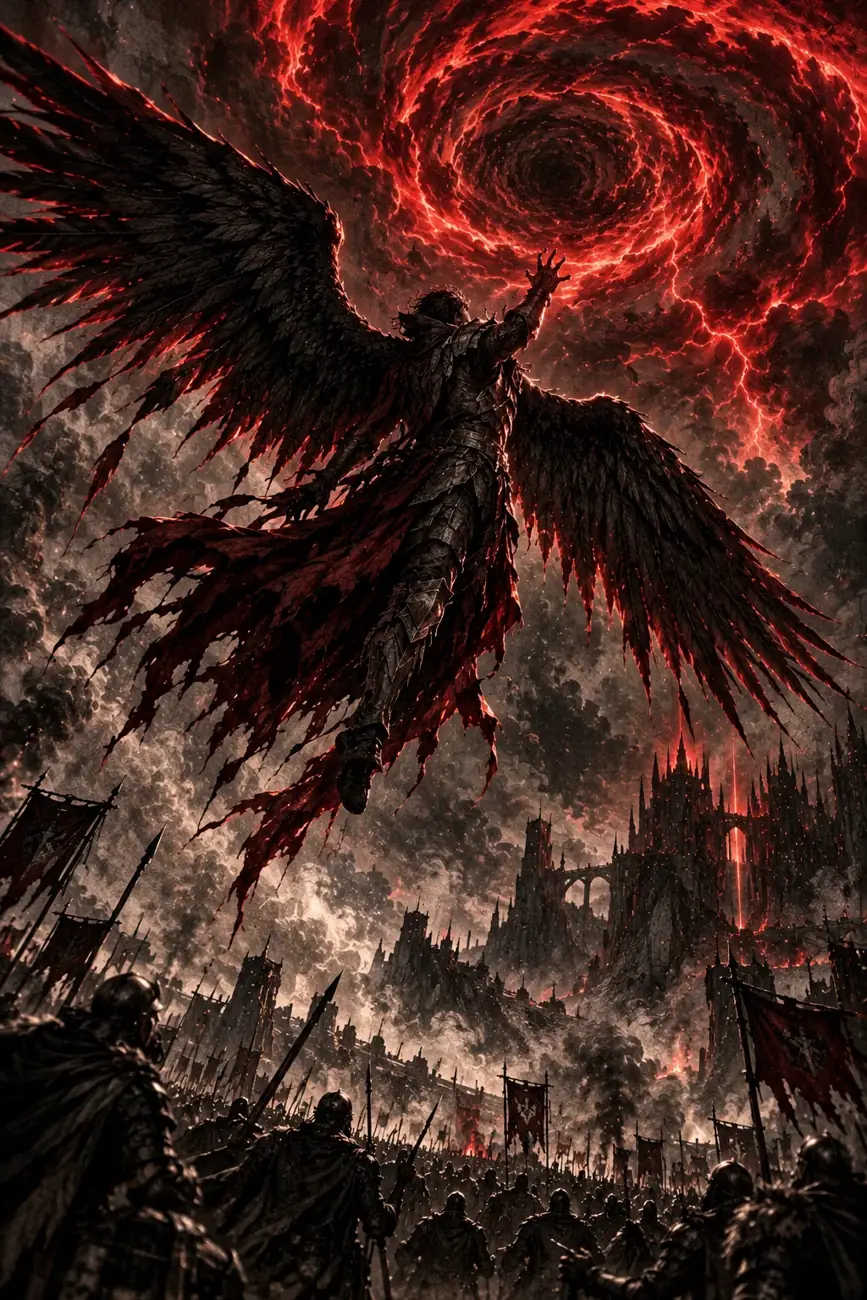
He could not explain the power. He did not know its limits, its price, or the reason it had chosen him. But he could feel it waiting beneath his skin, vast and responsive. For the first time, the world seemed less like a place that could hurt him and more like a thing that might bend if he asked it to.
He returned to the ridge as the enemy cavalry poured through the eastern breach. Caelan Voss had arrived with a handful of guards, his sword drawn and his face streaked with blood.
“My lord,” Caelan said, dropping to one knee. “The line is collapsing. We must withdraw to the fortress.”
Ray looked past him. The cavalry was packed tightly between two rocky outcrops, with infantry pressing behind it. The western commander had chosen speed over caution. The formation could not spread out or turn quickly, and the soldiers at the front had no idea what was waiting beyond the smoke.
Ray saw the whole shape of the battle at once. The rocks, the wind, the abandoned oil carts, the archers hidden beyond the ridge. Each piece seemed to click into place.
“Move the surviving infantry behind those rocks,” he said. “Leave the centre open. Pull the archers back beyond the ridge, but keep them hidden. Let the cavalry believe we have lost the line.”
Caelan looked towards the narrow passage. “They will enter in force.”
“That is what I want.” Ray pointed towards the abandoned carts. “When the front ranks pass the second marker, set the oil alight. The smoke will blind the men behind them. They will have no room to turn, and their own numbers will trap them.”
Caelan’s uncertainty gave way to understanding. “And when they break formation?”
“The archers fire. Our reserve riders take the northern road and cut off their commander. Do not chase every soldier. Break the army first.”
Caelan bowed his head. “As you command.”
Ray watched the captain run to carry out the orders. He had not studied the field. He had not calculated the distances. The answer had arrived whole in his mind, clear and cold, and he had known it was right.
He felt a flicker of unease at how easily he had understood the shape of violence.
Then the enemy horn sounded again, and the unease vanished beneath the urgency of the moment.
The cavalry entered the passage.
Ray raised his hand.
“Now.”
A flame leapt from his fingers and raced across the ground. It struck the first oil cart, and for a breath the cart seemed to swallow the fire. Then the entire passage erupted. Flames climbed the wheels and leapt to the next cart. Black smoke surged between the rocks. Horses reared, soldiers shouted, and the tightly packed formation folded in on itself.
The hidden archers released their first volley.
The arrows fell like dark rain.
Ray descended into the smoke.
He landed among the broken ranks and moved before the nearest soldier could recover. He turned a spear aside, broke the shield behind it, and drove the soldier backwards. Another came at him from the left. Ray stepped into the attack, caught the man’s wrist, and used his own momentum to throw him into the dust.
He was learning as he fought. The distance between an opponent’s intention and his movement seemed to open before him. He could read a shoulder turning, a foot shifting, a hand tightening around a weapon. His body answered with a speed that made ordinary reactions feel slow.
An enemy blade struck his side. The impact rang against his armour. Ray looked down. The weapon had broken, leaving his skin untouched beneath the torn fabric.
The soldier holding the hilt stared at him.
Ray smiled. “That was a mistake.”
The soldier ran. Ray caught him before he reached the rocks and struck him down. The motion was brutal and efficient, without the hesitation that had troubled him at the beginning of the battle. He did not stop to wonder whether he should have shown mercy. He moved to the next threat.
His soldiers saw the change. Their king had always been feared, but now he fought with a new and terrible intelligence. He used the enemy’s panic against them, drove them towards ground where their numbers became a weakness, and struck wherever their formation began to fail. His strength was extraordinary. His judgment was worse for his enemies: he understood exactly where to apply it.
When a knot of spearmen tried to surround him, Ray spread his wings. A burst of force tore through their line and scattered them across the ash. He rose above their weapons, swept over the broken wall, and descended behind the western captain before the man could turn his horse.
The captain swung at him. Ray caught the blade, twisted it from his hand, and sent him crashing against the stones. Around them, the remaining soldiers faltered.
“Stand your ground!” the captain shouted, trying to rise.
No one obeyed.
Ray looked across the retreating line. “You came here to take my land.”
He did not know why he called it his land. The words simply belonged in his mouth.
“Now you may leave it.”
The western commander ordered a retreat. Ray saw the movement and immediately turned towards the northern road.
“Caelan! Take the reserve riders around the western ridge. Cut off their commander before he reaches the river. The rest of the line is to secure the breach. Do not let them regroup.”
Caelan saluted and ran to carry out the order.
Ray spread his wings and rose above the fleeing army. From the sky, the retreat became a pattern of scattered shapes. He could see where the soldiers would turn, where the road narrowed, where panic would spread fastest.
He could have let them go. The battle was already decided. But when he remembered the broken wall, the men who had tried to kill him, and the fear that had filled their faces when he first took flight, a cold satisfaction settled over him.
He folded his wings and dived.
At the last moment, he opened them. The force struck the ground in a broad wave, lifting ash and hurling shields across the flats. The fleeing soldiers stumbled. Their formation broke completely.
Ray landed before the western commander near the river. The man raised his sword, though his arm trembled.
“You may have won this field,” the commander said, “but you have not conquered the western kingdoms.”
Ray looked at the scattered soldiers behind him. “Why not?”
“Men will always fight for their freedom.”
“Did you ask the people in the villages you burned whether they wanted your army here?” Ray asked. “Did you speak to them about freedom?”
The commander’s expression tightened. “Your soldiers have done the same.”
“Perhaps.” Ray stepped closer. “But I am standing here now, and you are the one holding a sword you cannot use.”
The commander lunged. Ray caught his wrist, twisted the weapon free, and let the sword fall into the dust. The man stumbled, suddenly unarmed before the very soldiers he had commanded.
“Pick it up,” Ray said.
The commander stared at him.
“Pick it up.”
The man retrieved his sword with shaking hands. Ray stepped back and waited. The commander looked at the black wings, the crimson light moving beneath the feathers, and the calm face of the man who had just given him another chance to attack.
At last, the commander lowered his weapon.
“I surrender.”
Ray watched him for a moment. “Good.”
He turned away. Behind him, the commander sank to his knees. One by one, the remaining western soldiers laid down their weapons. The sound of iron striking stone travelled along the riverbank.
The battle was over.
Only then did Ray notice the stream running beneath the cliff. He approached it to wash the blood and ash from his hands. The water was dark with soot, but it moved clearly enough to hold a reflection.
He leaned forward.
A stranger looked back at him.
The face was handsome in a severe, unsettling way: sharp cheekbones, a strong jaw, dark hair falling across the forehead, and eyes that seemed black until the light caught a deep crimson glow within them. A faint scar marked the skin near his mouth.
Ray touched his cheek. The stranger did the same.
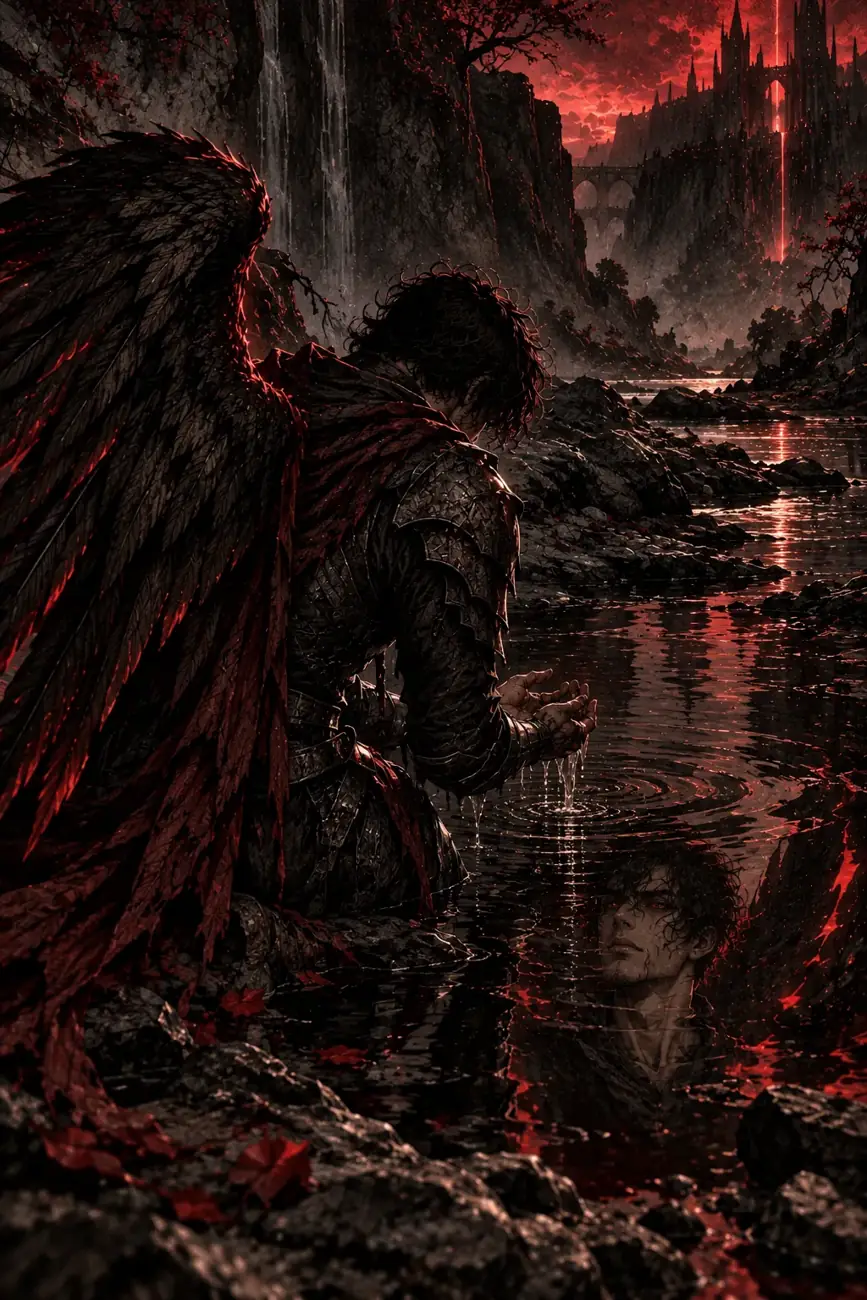
For an instant, he felt the distant ache of another face, another life, another body whose limits he had once known too well. The memory refused to become clear. It left only a quiet resentment, as though the reflection had stolen something from him.
“I don’t like you,” he told the water.
The words sounded strange, but honest.
He watched the ripples break his face apart. Then he looked over his shoulder at the wings reflected behind him, vast and black, edged with a red light that did not belong to the sun.
“But I love what you can do.”
He stood straighter. “I don’t care what you look like. Not anymore.”
He did not know why he had once cared so much about a face or what he had hoped to become. The memory was too far away. What remained was the certainty that this body could do things the old one never could. It could run. It could fly. It could make armies kneel and storms answer a raised hand.
He looked towards the battlefield and smiled at the thought.
By sunset, the Cinder Flats belonged to him. The Black Guard had reclaimed the eastern wall and raised its banners above the broken watchtowers. The surviving western soldiers were disarmed near the river, and the wounded were carried away from the burning siege engines. Smoke drifted across the land in long, dark ribbons.
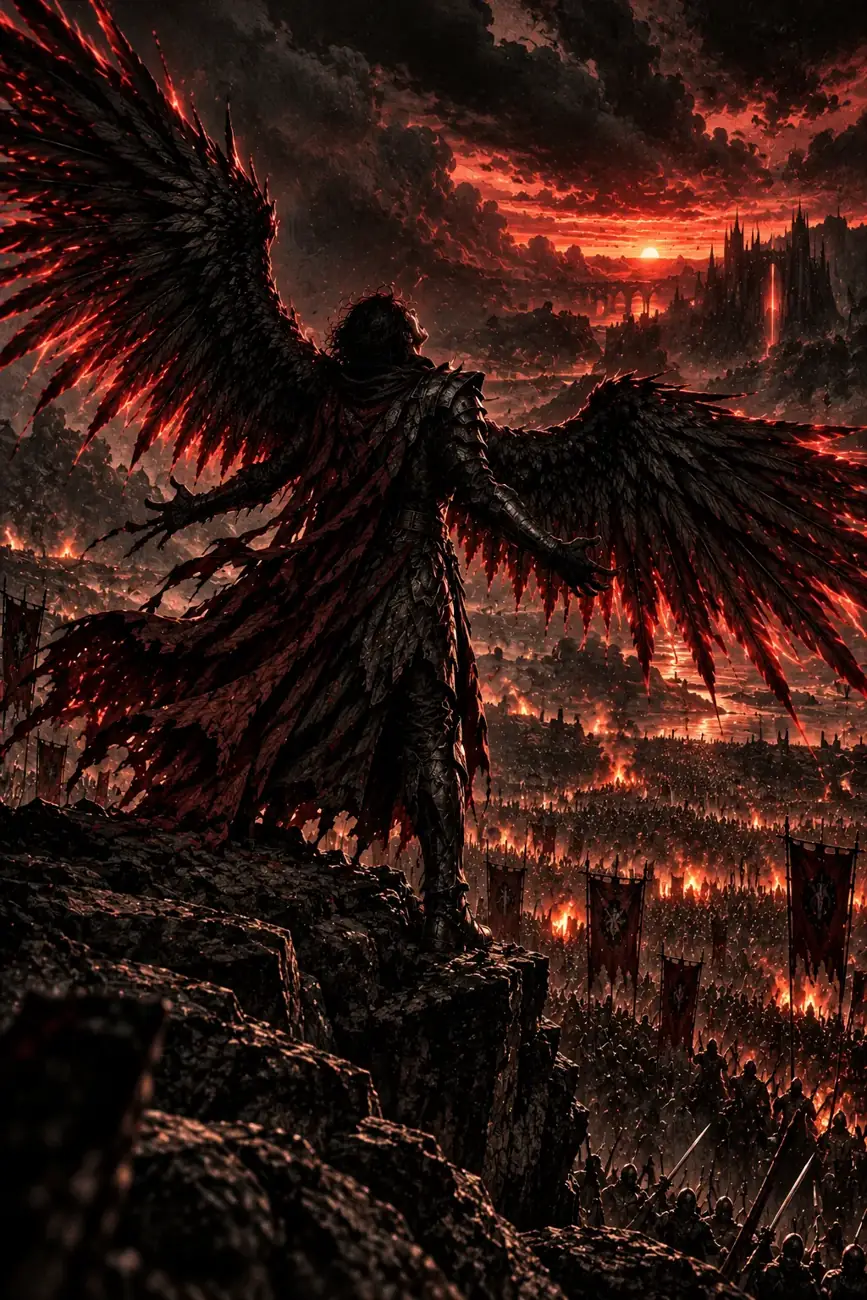
Ray climbed to the highest cliff overlooking the flats. Below him, the conquered battlefield stretched towards the river and beyond it into the mountains. Fires glowed among the wreckage. The dead lay in rows where the fighting had ended, and the living moved like shadows through the ash.
Caelan Voss approached from behind and stopped several paces away.
“My lord.”
Ray did not turn. “How many?”
“Four hundred and twelve of ours are confirmed dead. We are still searching the eastern trenches. The western losses are considerably higher.”
Ray watched the fires. He knew that he should feel grief, or at least the weight of what had happened. Instead, the deaths seemed distant, like numbers written on a report. He could see what he had done, but the expected sorrow would not come.
“Find the rest of our wounded,” he said. “Get them water and shelter. The prisoners are to be disarmed and kept alive until I decide what comes next.”
Caelan bowed. “As you command.” He hesitated, then added, “I have served you for eleven years. I have seen you bring kingdoms to their knees. But I have never seen you fight like this.”
Ray glanced at him. “Like what?”
Caelan looked towards the battlefield. “Unstoppable.”
The word pleased him more than it should have.
Below the cliff, a murmur rose among the soldiers. One voice called his name. Another answered. Soon the sound spread through the ranks, growing louder as men raised their swords and black banners against the evening sky.
“Lucifer!”
Ray stood motionless.
He had heard the name before. He had spoken it beside the stream. But now it belonged to the wings, the storm, the roar that had shaken the mountains, and the soldiers who had watched him turn defeat into victory.
“Lucifer!”
The name rolled towards the cliff. Something stirred in the deepest part of his mind: a bright room, a voice, the impression of a hand reaching for his. The fragment lasted only a heartbeat before the shouting swallowed it.
He could have chased the memory. He could have asked who he had been, what he had lost, and why the name Ray still seemed to echo from somewhere beyond his reach.
Instead, he looked down at his hands. They were steady. Strong. His wings shifted in the wind, and the storm gathered faintly above the mountains as though waiting for him to call it again.
He had wanted to be powerful. He could no longer remember when that desire had begun, or what he had once hoped power would give him. But the desire remained, stripped of every explanation and sharpened into something almost pure.
He wanted to rise above the world. He wanted no one to look down on him again. He wanted a strength that could never be taken away.
Now he had it.
Ray turned towards the soldiers and spread his wings to their full span. The shouting stopped. Thousands of faces lifted towards him. Crimson light moved beneath his feathers, and the clouds above the battlefield darkened.
“Let them remember this day,” he said. His voice carried across the cliff. “Let them remember what happened when they came for my kingdom.”
He drew a breath and roared.
The sound did not belong to a human throat. It began deep in his chest, a low vibration that seemed to shake the air before it became audible. Then it grew into the roar of a dragon, rolling across the Cinder Flats with enough force to tremble the old watchtowers. Loose stones fell from the ruined walls. The stream shuddered. Horses cried out, and soldiers who had survived the battle dropped to their knees.
The roar travelled into the mountains and returned as thunder.
For one moment, the entire world seemed to hold its breath.
Then his people answered him.
“Lucifer!” they cried, raising their weapons. “Lucifer! Lucifer!”
He looked across the conquered land, at the burning field and the banners that now flew beneath his command. The name no longer sounded like a stranger’s answer. It was not a question. It was not something borrowed from frightened men. It was his.
He would not search for a past he could not reach. He would not kneel before a life he could no longer remember. Whatever waited beyond the darkness could wait. He had a kingdom, wings, and power enough to make the world tremble.
He smiled at the people roaring beneath him.
Lucifer.
The King of the Dark.
And somewhere, buried beneath the ash of a life he could no longer reach, Ray Ezhil disappeared into silence.
The battle had ended.
Lucifer had been born.
Nila woke to the sound of birds.
For a few seconds, she did not open her eyes. The sound was so clear and close that she imagined a pair of sparrows had found their way into the bedroom. One bird called from somewhere above her, another answered from the garden, and a third seemed determined to interrupt them both. Their song moved through the room with the confidence of something that had never learned to be afraid.
Then she noticed the scent of roses.
It was not the faint fragrance of a flower placed in a vase. It surrounded her, mingling with the clean smell of linen, warm stone, and water. Somewhere nearby, a fountain murmured. Sunlight lay across her face, gentle and golden, and the bed beneath her was so soft that for one disorienting moment she thought she had been returned to a dream.
She opened her eyes.
The ceiling rose high above her, painted with pale clouds and small figures whose faces seemed to turn towards the morning. Fine gold lines traced the edges of the canopy. Curtains the colour of cream hung from carved wooden posts, moving slightly in a breeze she could not yet feel. Near the far wall, water spilled from a marble basin into a shallow pool. White flowers floated on its surface.
Nila sat up too quickly.
The room swayed. She caught the edge of the bed and held on, breathing through the sudden rush of panic. The Gate came back in fragments: the laboratory lights, Elena shouting, the strange brightness swallowing the world, and the decision she had made before fear could persuade her to stay behind.
She had crossed.
She had actually crossed.
Her hands began to tremble. She pressed them together, then looked at them properly. The fingers were elegant, the nails neat, and a gold bracelet rested against her wrist. It was not the bracelet that frightened her. It was the ease with which the hand moved, the unfamiliar grace of it, the sense that she had borrowed a body whose every gesture carried a history she did not know.
She swung her legs over the side of the bed and stood. The floor was cool beneath her feet. She waited, half expecting the room to vanish or the world to reject her, but nothing happened. Her knees held. Her balance was steady. She was here.
A tall mirror stood between two carved pillars. She approached it slowly.
The woman in the glass was beautiful in a way that made Nila uncomfortable. Her face held a luminous stillness, her eyes bright and unfamiliar, her dark hair spilling in waves over her shoulders. There was a softness to her features and a confidence in the way she stood, as though the body had never entered a room without being noticed.
Nila lifted a hand to her cheek. The reflection followed.
“Aphrodite,” she whispered.
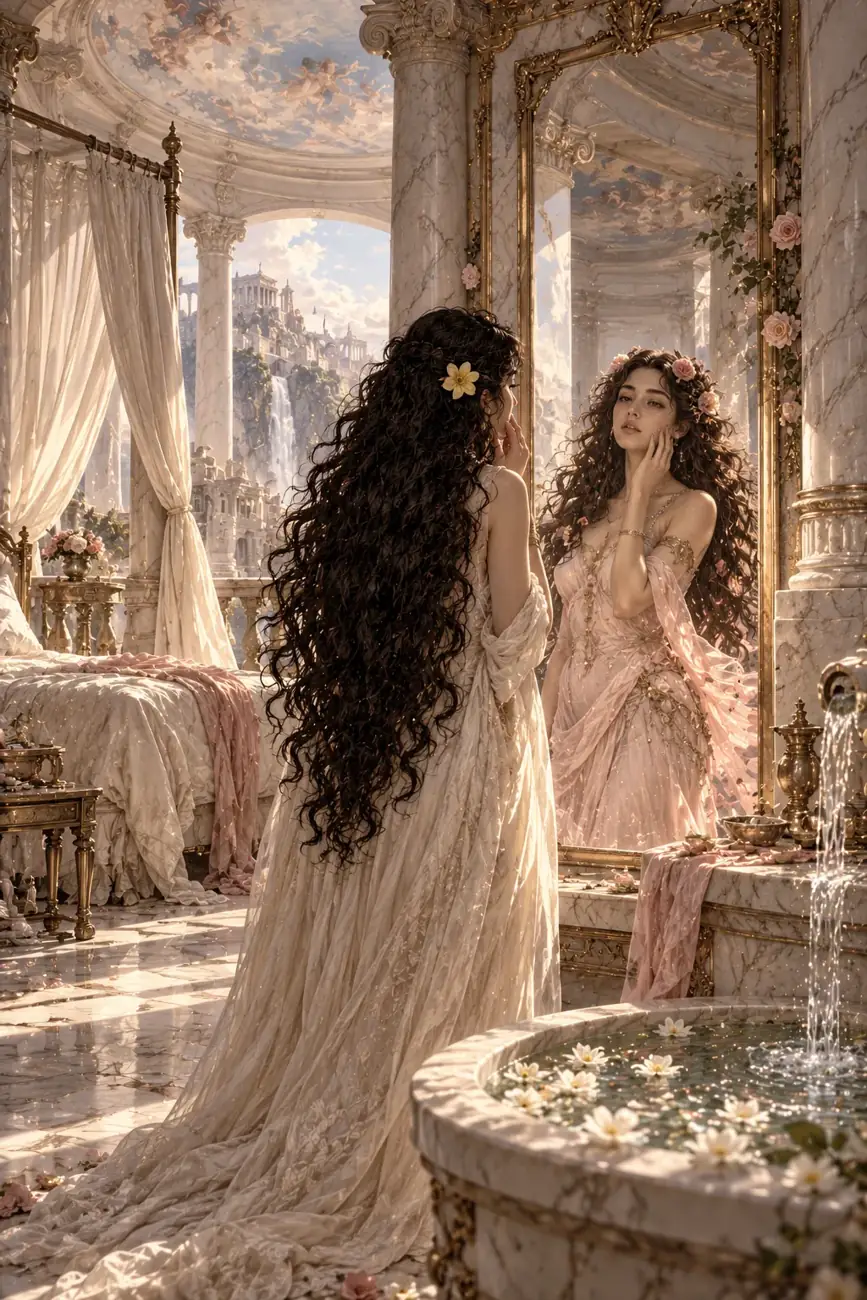
The name sounded too large in the quiet room.
She had heard stories about this goddess since childhood. Love, desire, beauty, jealousy, devotion, the dangerous power of being wanted. In the stories, Aphrodite could make kings forget their kingdoms and turn the proudest hearts into helpless things. People prayed to her when love frightened them, when it abandoned them, when they wished to be chosen.
Now those people might kneel before Nila.
Her stomach tightened.
“I am not you,” she told the reflection.
The face in the mirror offered no answer.
For one sharp moment, she wanted to run. She wanted to find the Gate, demand that someone open it, and return to the world where her name was her own. But there was no Gate in this room, no familiar voice in the corridor, no assurance that the people she had left behind could bring her back. She did not even know whether her body in the laboratory was still alive.
And Ray was somewhere beyond this world.
The thought rose so suddenly that she had to close her eyes. She would not let herself follow it yet. If she began imagining what might have happened to him, the panic would swallow everything else.
She drew a slow breath and turned away from the mirror.
First, she needed to understand where she was. Then she needed to learn how to survive here without letting anyone discover that the woman they knew as Aphrodite had become a stranger inside her own skin.
She crossed the room and reached for the tall doors leading to the balcony. The handles were warm from the sun. She opened them herself.
Olympus unfolded before her.
The city descended in pale terraces along the mountain, its marble roofs and sunlit columns gleaming beneath a sky of impossible blue. Gardens filled the spaces between buildings. Rose vines climbed over low walls, and cypress trees stood in dark green rows beside broad stairways. Far below, a stream wound through the city, passing under small bridges and opening into a bright pool where children were already playing.
Beyond the rooftops, mountains lifted their blue shoulders into the distance. Beyond them lay the sea, vast and silver, its horizon so clear that sky and water seemed to have made a quiet agreement to become one.
Nila forgot to breathe.
She had imagined Olympus as a place made of marble, clouds, and grand stories. She had not imagined the laundry hanging from a balcony. She had not imagined a baker carrying a basket through a crowded lane, a pair of old men arguing beside a fountain, or a little girl chasing a white dog that refused to be caught. A woman leaned from an upper window to call something to a neighbour. Somewhere, a musician practised the same short phrase over and over, missing a note each time and beginning again.
The world was not posing for her.
It was living.
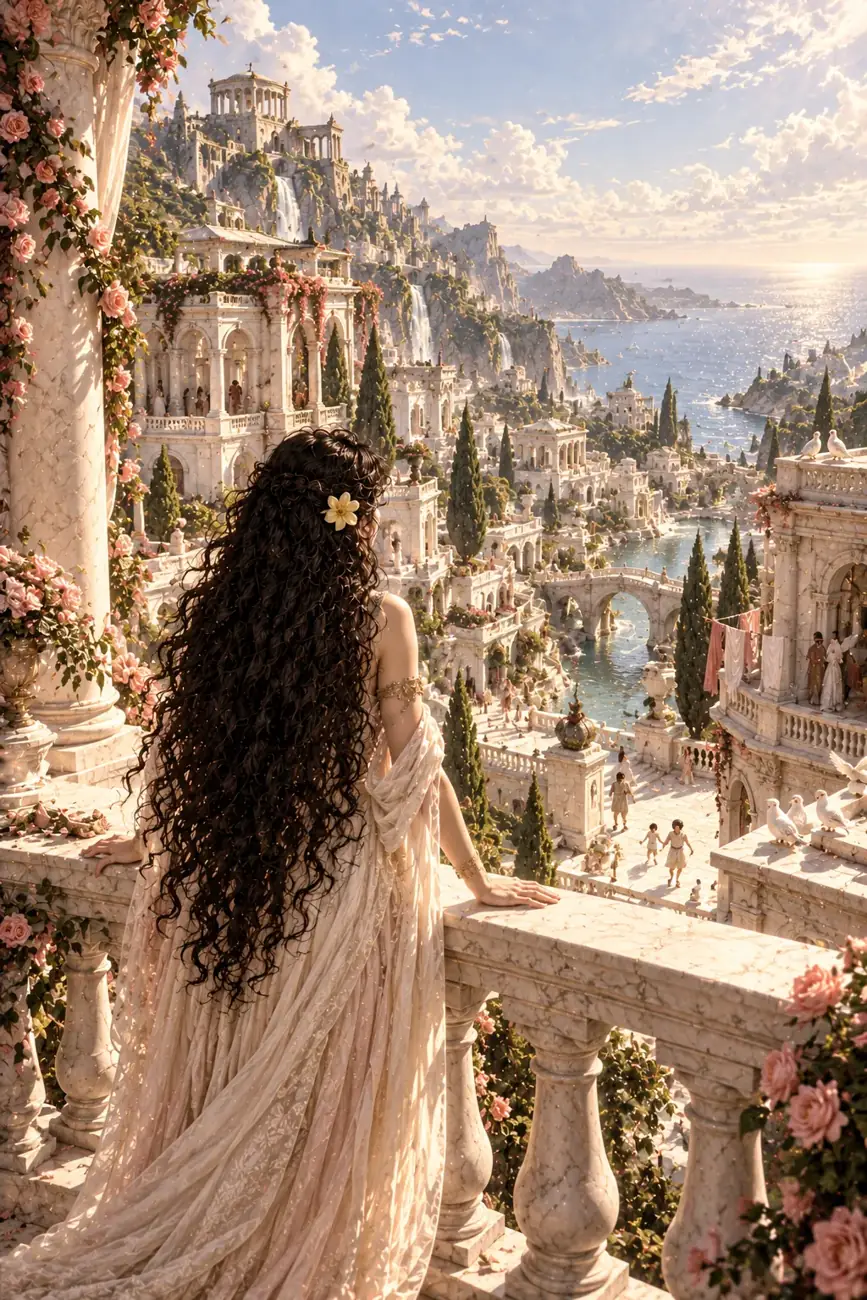
A laugh escaped her, small and disbelieving. She leaned her hands against the warm stone balustrade and looked down at the gardens. Butterflies moved among the flowers. Doves gathered on a roof, their wings flashing in the sun. The breeze carried the fragrance of roses up from the lower terraces.
She loved it.
The realisation arrived before she could defend herself against it. She loved the light on the buildings, the music from the distant square, the ordinary movement of people beginning their day. She loved the fact that this impossible place contained small, familiar things: a child who did not want to go where she was being called, a vendor arranging fruit, someone laughing too loudly at a private joke.
For a moment, wonder loosened the fear around her heart.
Then a knock sounded behind her.
Nila turned so quickly that her hand struck the stone railing.
“My lady?” called a woman from the other side of the door. “Are you awake?”
Nila looked around the room. She had no time to decide what Aphrodite would say. She wiped her palms against her gown, forced her breathing to settle, and crossed back inside.
“Yes. Come in.”
Two women entered.
The older woman carried a folded robe over one arm and a small tray in the other hand. Her hair was pinned beneath a simple linen wrap, and her expression held the efficient calm of someone who had been managing the same household for years. The younger woman followed with a bowl of fresh water and a bundle of flowers. She looked to be in her late teens, with bright eyes, a quick smile, and the alert curiosity of someone who noticed far more than she said.
“You are awake at last,” the older woman said. “I was beginning to think the spring ceremony would have to begin without you.”
Her tone was familiar, almost affectionate. She did not bow as a stranger might have done. She set the tray down and looked Nila over with the frank concern of someone who had seen her ill, angry, impatient, and tired many times before.
“I slept badly,” Nila said, choosing the simplest explanation she could manage.
“You slept through the first bell,” the younger woman corrected gently. “And the second.”
The older woman gave her a warning look. “Lyra.”
“What? She always tells me I should wake her if the morning is beautiful.” Lyra glanced towards the open balcony. “It is beautiful.”
Nila looked at her, surprised by the easy warmth in her voice.
“You are right,” Nila said. “It is.”
Lyra smiled, as though this answer pleased her more than it should have.
The older woman introduced herself as Mara, the senior attendant responsible for the morning preparations. She began explaining the day’s schedule while arranging the robe and laying out a pair of delicate sandals. Nila listened carefully, catching names and duties as they passed: the first garlands at the lower temple, the spring blessing, petitions from the city, a gathering in the inner court, and a meal with Dorian and the children before the ceremony.
Dorian.
The name meant nothing to Nila, but the way Mara spoke it suggested that it should.
“Will he be there this morning?” Nila asked, trying to make the question sound casual.
Mara looked up. “Your husband? He has already sent twice to ask whether you are feeling better.”
Nila felt the floor shift beneath her, though it did not move at all.
Her husband.
She looked down at the bracelet on her wrist. It seemed suddenly heavier.
“Of course,” she said. “I only wanted to know whether he had gone to the council.”
“He delayed it.” Mara’s expression softened. “He was worried about you.”
Lyra had been watching Nila rather than listening to the schedule. When Nila met her eyes, the young woman looked away, but not before a flicker of concern crossed her face.
“I am a little confused this morning,” Nila said. She chose each word carefully. “I did not sleep well, and everything feels as though it has come to me at once. Could you remind me of the order of the day?”
Mara’s concern deepened, but she did not challenge her. She explained the arrangements again, more slowly. Aphrodite was expected to bless the garlands, receive the first petitions, and appear before the people at the lower temple. It was not an unusual duty, she said. The city held the ceremony every spring, and the goddess had never missed it.
Never missed it.
Nila felt the responsibility settle over her shoulders like another garment.
She could not tell these people the truth. She could not say that she had arrived from another universe, that she did not know their customs, that she had no idea how to be the goddess whose face she wore. If she did, she might lose the only shelter she had found. Worse, she might place the lives of these people in danger by exposing something no one here was meant to understand.
So she nodded.
“I will be ready.”
Mara seemed relieved. She began giving instructions about the robe and the flowers. Lyra moved closer to the balcony doors and quietly gathered a few blossoms that had fallen onto the stone. She placed them in a small bowl, then returned to the tray without drawing attention to herself.
Nila noticed.
She noticed the way Lyra had looked at her hands when she first entered. She noticed how the girl watched her pause before answering simple questions, how she listened to the tone of Nila’s voice as much as to the words. It was not suspicion exactly. It was attention, sharpened by affection.
That frightened Nila more than open suspicion would have.
“Lyra,” she said, before the younger woman could leave with Mara. “Would you stay a little while?”
Mara turned. Lyra looked up in surprise.
“Of course, my lady.”
Mara hesitated, then inclined her head. “I shall have the rest of your things brought in. Try not to be late again.”
“I shall try,” Nila replied.
The older woman left. Lyra remained by the table, her fingers resting lightly on the edge of the bowl.
For a few seconds, Nila could not think of a question that would not betray her. She wanted to ask who she was supposed to be, what Dorian expected of her, how many people in this palace knew Aphrodite well enough to notice a change in her breathing. Instead, she asked the only thing she could safely ask.
“How long have you served me?”
Lyra tilted her head. “Since I was small enough to hide beneath the linen tables when the court became too noisy. My mother worked in the lower gardens. You used to bring me fruit when she was busy.”
Nila felt a pang of tenderness for a childhood she had never witnessed.
“Did I?”
“You did.” Lyra smiled at the memory. “You told me the fruit was a secret and that I must never tell anyone. Then you gave me so much that I could barely carry it.”
The story was simple. That made it harder to bear.
Somewhere in this world, the real Aphrodite had laughed with this girl, had offered her kindness, had left small memories that still mattered. Nila had not created those bonds. She had inherited them without permission.
“She sounds kind,” Nila said quietly.
Lyra’s smile faded a little. “You are kind.”
The words landed more gently than an accusation, but Nila could not accept them without feeling the weight of the truth.
“I hope I can be.”
Lyra studied her. For a heartbeat, she looked as if she might ask something important. Instead, she picked up the bowl and moved towards the balcony.
“The city is especially beautiful after the first rain,” she said. “You should see the gardens below the temple. The roses open all at once, and the whole path smells like summer.”
“I would like that.”
“Then I will show you, if you have time after the ceremony.”
Nila looked at her. There was no calculation in the offer, no demand for an explanation. Only a young woman extending a small bridge across a distance she did not yet understand.
“Thank you, Lyra.”
Lyra lowered her eyes, but Nila caught the faint colour that rose in her cheeks. The girl was fascinated by the goddess she had grown up serving, but she was also beginning to sense that the woman before her was carrying a sadness she could not name. She did not ask. Not yet.
A knock sounded again, and this time the room filled with the quiet movement of attendants bringing the rest of the morning’s preparations. Nila allowed them to arrange her hair and fasten the robe around her shoulders. She studied every gesture, every object, every response. When someone addressed her, she answered with calm deliberation. When she did not know something, she blamed the poor sleep. She listened more than she spoke.
She would learn.
She would remember the names, the duties, the rituals. She would treat the people who came to her with care. She would not mock their faith or dismiss the lives they had built around the goddess they believed in. If she had been placed in Aphrodite’s position, then she would try to honour the responsibility, even while knowing she had no right to claim the life entirely as her own.
The decision did not erase her guilt. It gave the guilt somewhere to go.
By the time the attendants finished, the room had filled with sunlight. The robe fell in pale folds around her, and a small spray of roses had been pinned into her hair. When Nila looked in the mirror again, she could almost understand why people might believe this woman was divine.
Almost.
She did not mistake the reflection for herself. She did not feel entitled to the beauty, the palace, or the devotion waiting beyond the doors. But she could use the position to do good. She could be gentle where she was expected to be vain, patient where she was expected to be proud, and careful with the hearts people placed in her hands.
For now, that would have to be enough.
The inner doors opened, and Dorian entered without ceremony.
He was dressed in a simple tunic beneath a dark cloak, his hair still damp as though he had washed in haste. He carried the worried expression of someone who had spent the morning pretending not to be worried. When he saw Nila standing, he stopped just inside the room.
“There you are.”
His relief was so natural that it hurt.
He crossed the room and reached for her hand. Nila let him take it, though every instinct told her to pull away. His touch was warm and familiar to the woman he believed her to be. To Nila, it was a kindness she had not earned.
“You frightened me,” he said. “Mara told me you were awake, but I wanted to see for myself.”
“I am sorry.”
He searched her face. “You do not need to apologise for being tired. You have been carrying too much these last few days.”
Nila held on to that sentence. It offered her a reason for being quieter than usual, a small shelter she could step beneath.
“I think I need a gentler morning,” she said.
“Then we shall give you one.” He smiled, and the ease of it suggested a history of ordinary compromises. “I have delayed the council. We can eat together before the ceremony, if you still wish to go.”
“I do.”
“Good.” He lifted her hand and pressed a kiss to her knuckles. “The city has been waiting for the spring blessing. You know how they become when the first roses open.”
Nila smiled because she understood the feeling, if not the tradition. “I have noticed that the roses are very persuasive.”
Dorian laughed softly. “That is one way to describe them.”
For a moment, she almost relaxed. He was not a stranger behaving like a stranger. He was a man who loved the woman he believed she was, and his affection had the quiet shape of habit. That made the deception more painful, not less.
He noticed the tension in her shoulders. “Are you certain you feel well enough?”
“I am certain I should not miss the day.”
Dorian looked as if he wanted to argue, then thought better of it. “At least let me walk with you to the dining room.”
“I would like that.”
He offered his arm. Nila took it.
They moved through a corridor lined with painted panels showing the seasons. Servants greeted them as they passed. Some smiled at Aphrodite with easy familiarity; others bowed, lowering their eyes. Nila returned each greeting as naturally as she could. Every exchange reminded her that the goddess was not simply a face or a title. She was woven into the daily lives of the people who served her.
In a small dining chamber overlooking the gardens, two children waited beside a table set with bread, fruit, honey, and bowls of warm milk.
The younger one, Phaon, saw her first. He jumped from his chair and hurried towards her.
“Mother!”
He wrapped both arms around her waist.
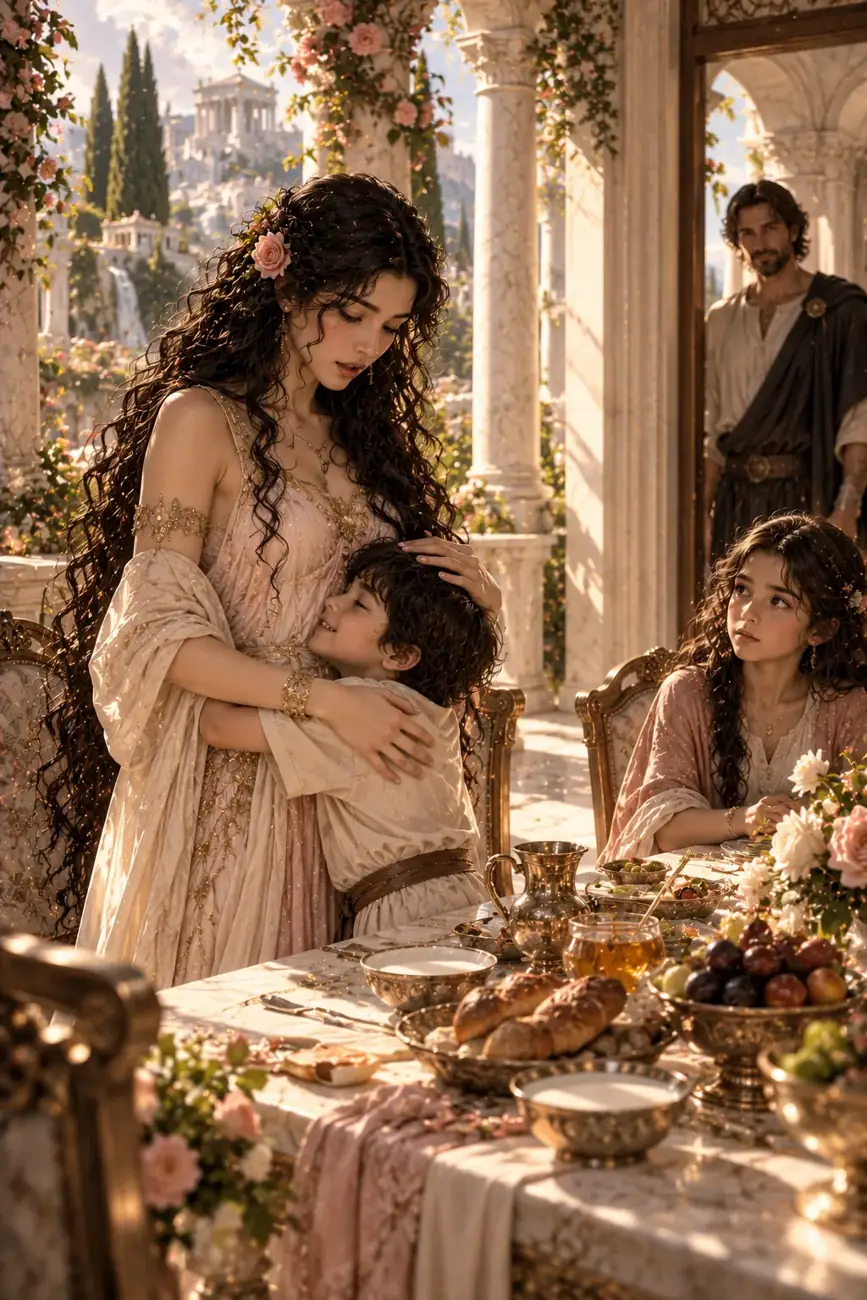
Nila went still.
For a brief, terrible second, she did not know what to do with her hands. Then she placed one against the boy’s hair. He leaned into the touch without hesitation, trusting her completely.
“Good morning,” she managed.
“You promised I could carry the first garland today.” He drew back to look up at her. “You did not forget, did you?”
The question pierced her.
She could not remember making that promise. She could not remember the small hand that had perhaps tugged at her sleeve, or the excitement in this child’s face when she had agreed. Yet the promise existed. The trust existed. The boy was waiting for her to keep it.
“No,” Nila said softly. “I have not forgotten.”
She would keep this promise, even if she had to learn how.
Melia watched from beside the table. Older than her brother, she had a composed face and an observant gaze. She did not rush to embrace Nila. Instead, she studied her mother with a quiet seriousness that made Nila feel she was being examined by someone far more perceptive than a child should need to be.
“You look different today,” Melia said.
Dorian glanced at her. “Melia.”
“Not bad,” the girl added quickly. “Just different.”
Nila lowered herself into a chair. “Perhaps I am tired.”
Melia considered that answer. “You should eat, then. You always say people become unkind when they are hungry.”
Phaon nodded solemnly, as if this were a law of the universe.
Nila laughed before she could stop herself. The sound surprised her. It was not Aphrodite’s laugh, whatever that might have been. It was simply her own, emerging in a room where she had expected only fear.
The children began speaking over one another. Phaon described the garland he wanted to carry. Melia corrected his account of how the ceremony worked. Dorian tried to settle the argument and failed. Nila listened, asked a question when she could, and let their ordinary happiness draw her into the morning.
She ate a piece of bread with honey. The fruit tasted bright and sweet. The milk was warm. Sunlight moved slowly across the table, catching in the glass bowls and the children’s hair.
She loved this, too.
The city outside. The garden. The warmth of a family gathered around breakfast. Even the ache of guilt seemed, for a moment, to belong to something meaningful. This was a life with responsibilities and small joys, a world in which people depended on one another.
She could not pretend it was hers.
But she could care for it while she was here.
After breakfast, Phaon insisted on showing her the garland he had helped prepare. It was a circle of white flowers threaded with roses, a little uneven on one side. Nila crouched beside him and examined it with solemn attention.
“It is beautiful,” she said.
“The flowers kept falling out.”
“Then it has survived a difficult morning. That makes it more impressive.”
Phaon beamed.
Melia watched them, her suspicion softened by amusement. Dorian stood near the doorway, looking at Nila with quiet affection. For the first time since waking, she understood how easily she might become attached to this place. Not because it was perfect, but because it was full of people who made it real.
That frightened her almost as much as the Gate.
If she stayed too long, would she begin to forget the world she had left? Would she become comfortable in a life that belonged to another woman? Would she one day look into the mirror and stop searching for her own face?
She pushed the thought away. She had not come here to replace Aphrodite. She had come because Ray was lost somewhere in the impossible distance between worlds.
She would remember that purpose, even when this world gave her a thousand reasons to remain.
The hours that followed filled quickly. Mara returned with the final arrangements. Lyra helped fasten the garland to a small carrying frame for Phaon. Dorian walked beside Nila through the palace courtyard, explaining the order of the ceremony and the names of the families who would attend. Nila listened closely, storing each detail away.
At the courtyard gate, she noticed the woman in the dark veil.
The stranger stood beneath a cypress tree across the lane, half hidden by the shadow of its branches. Her clothing was plain, almost severe, and she carried no basket or offering. She did not bow when Aphrodite passed. She did not turn away, either.
She watched.
Nila glanced towards her again a moment later. The woman had moved to the far side of the street, keeping pace with the small procession without appearing to follow it. When the crowd thickened, she disappeared behind a group of petitioners.
“Do you know her?” Nila asked Lyra quietly.
Lyra followed her gaze, but the street was crowded. “Who?”
“A woman in a dark veil. Near the cypress tree.”
Lyra searched the passing faces. “I did not see anyone, my lady.”
Nila looked once more towards the crowd.
There was no sign of the stranger.
She told herself that Olympus was full of people and that being watched was probably ordinary for a goddess. Still, the woman’s stillness stayed with her. She had not looked at Aphrodite with devotion, fear, or envy. She had looked at her as though she were trying to solve a question.
The thought remained with Nila as the procession began its descent towards the lower temple.
The city grew louder around them. Vendors called to customers. Children ran alongside the procession until their parents drew them back. Flowers were scattered across the steps, and the temple bells sounded above the music. People bowed as Aphrodite passed, their faces lifted with hope.
Nila felt the weight of their expectations.
They were not asking her to prove she was divine. They were asking her to be present. To listen. To offer some comfort when their own lives felt too heavy to carry.
She could do that.
She might not be the goddess they believed in, but she knew what it meant to love someone, to fear losing them, to hope that a difficult truth could still lead to a gentler future. She knew that love was not a spell that made people perfect. It was the choice to see another person clearly and care for them anyway.
As the temple doors opened, the sunlight fell across the garlands and turned the white petals almost translucent.
Nila stepped forward.
She would be Aphrodite for as long as this world required her to be. She would learn the duties, honour the people, and guard the secret of her arrival. She would not allow fear to make her careless with the life she had been entrusted to inhabit.
But the promise she carried from her own world remained alive beneath every new responsibility.
Ray.
She did not speak his name. Not here, not before these people. She kept it safely inside herself as she crossed the temple threshold and began the work of the day.
The ceremony passed in a blur of music, flowers, and voices. Nila listened to the priest recite the blessing. She watched Phaon carry the first garland with fierce concentration, both hands gripping the frame. When he looked up to make sure she was watching, she smiled, and his shoulders straightened with pride.
A young woman approached with a petition, her fingers twisting the edge of her shawl. Nila listened without interrupting. A father asked for peace with his daughter. An old couple wanted a blessing for a marriage that had survived decades but was now being strained by illness. Nila did not promise that love would spare them suffering. She asked what they had tried, what they had not said, and what they were still willing to do for one another.
Some people left disappointed that she had not offered a miracle. Others left with wet eyes and a steadier expression. One woman took Nila’s hands and thanked her for listening as though the act itself had been a gift.
Each encounter made the role feel less like a costume and more like a responsibility. That did not make the guilt disappear. It made her more careful.
Throughout the ceremony, Nila noticed the veiled woman again and again. At the edge of the square. Beneath a column. Across the courtyard where the shadows from the cypress trees crossed the paving stones. Never close enough to be challenged, never far enough for Nila to convince herself she had imagined her.
Once, their eyes met.
The woman did not bow.
Nila felt a chill beneath the warm sunlight.
Then someone called her name, and when she looked back, the stranger had vanished.
By late afternoon, her feet ached. Her cheeks hurt from smiling, and the careful calm she had maintained all day began to feel like a garment fastened too tightly. Dorian noticed her fatigue and arranged for the family to return to the palace before the final gathering.
On the way back, Lyra walked beside her rather than behind. She told Phaon a story about a dove that had stolen a ribbon from a temple statue. Phaon interrupted every few sentences to suggest a different ending. Melia pretended not to listen but corrected the story whenever Lyra changed a detail.
Nila listened to them and felt something tender open inside her.
She wanted to keep this memory, even though it was not hers.
At the palace, Dorian kissed her forehead before leaving to meet with the council. Melia hugged her briefly, then pretended she had only come to retrieve a book. Phaon fell asleep before the evening meal, his hand still curled around a loose white flower from the garland.
Nila watched him sleep for a moment.
“He trusts you,” Lyra said softly from the doorway.
Nila turned. “He trusts his mother.”
Lyra did not answer at once.
“Perhaps,” she said finally. “But he trusts the person who is here with him, too.”
There was something careful in the way she said it.
Nila studied the young servant. “You have been watching me all day.”
Lyra’s eyes widened, but she did not pretend otherwise. “I have.”
“Why?”
The girl glanced towards the sleeping child. “Because you look at things as though you have never seen them before. You listened to people today in a way you sometimes forget to. And when Phaon asked about the garland, you looked as if he had handed you something precious and frightening at the same time.”
Nila felt her pulse quicken.
“I was tired.”
“I know.” Lyra’s voice softened. “I am not asking you to explain anything.”
That answer surprised Nila more than a direct accusation would have.
Lyra picked up the fallen flower and placed it on the bedside table. “Whatever has changed, you do not have to tell me tonight. I only wanted you to know that if you need help remembering the order of things, or if the palace feels too large, you can ask me.”
Nila looked at her for a long moment.
The girl had noticed. Perhaps she had noticed from the first moment she entered the room. Yet instead of exposing her, she had offered help without demanding the truth. Nila could not know whether Lyra was merely kind or whether curiosity had made her cautious. She could only see that the offer was real.
“Thank you,” she said, and this time the words carried everything she could not safely explain.
Lyra smiled, then slipped quietly from the room.
Night settled over Olympus slowly. The last sunlight withdrew from the columns, leaving the marble rose-coloured for a few moments before it turned silver beneath the rising moon. Lamps were lit along the garden paths. The city softened into distant voices and music, and the sea beyond the mountains became a dark sheet scattered with stars.
Nila waited until the palace grew quiet.
She returned to the balcony alone.
The air was cooler now. She wrapped her arms around herself and leaned against the stone railing. From this height, Olympus seemed almost peaceful enough to be a dream. The gardens lay beneath her in dark patterns. White flowers glimmered in the moonlight. Somewhere below, a fountain continued its patient song.
She had loved the place all day.
She loved it still.
That was the part she had not expected. She had thought fear would be the only thing she felt, that every beautiful thing would remind her of the danger she was in. Instead, Olympus had reached her through its ordinary kindness: a child trusting her with a garland, a husband worried for her, a young servant offering help without asking for anything in return.
She wanted to protect them.
She also wanted to go home.
Both truths lived inside her, and neither would surrender to the other.
Nila looked up at the stars. They were sharper here, scattered across the dark as if the sky had been swept clean. She wondered whether the same stars shone over the laboratory, whether Elena was watching the monitors, whether the team had found a way to keep the Gate open. She wondered whether her own body was still breathing.
Then she thought of Ray.
Not as a scientist in a laboratory. Not as a man whose choices had led them both into danger. She thought of the person behind the messages, the quiet humour, the tenderness he tried to hide beneath clever words. She remembered the promise he had made her, the impossible promise to build a Paradise where they could be free to exist without the world telling them what they were allowed to become.
Her throat tightened.
“Ray,” she whispered.
The name disappeared into the night.
A star fell across the sky.
It was brief, a bright line of silver slipping behind the mountains. Nila watched until it vanished, then pressed her fingers against her lips. The tears came quietly at first, blurring the lights of Olympus. She did not wipe them away.
All day, she had been Aphrodite. She had listened, smiled, learned, and carried the hopes of people who believed the goddess could help them find love or mend what love had broken. She had done her duty as carefully as she knew how.
But beneath the robe, beneath the borrowed name and the beautiful face, she was still Nila.
She was still the woman who had crossed a universe because she could not accept that Ray might be lost beyond her reach.
She placed one hand over her heart.
“I am coming for you, Ray.”
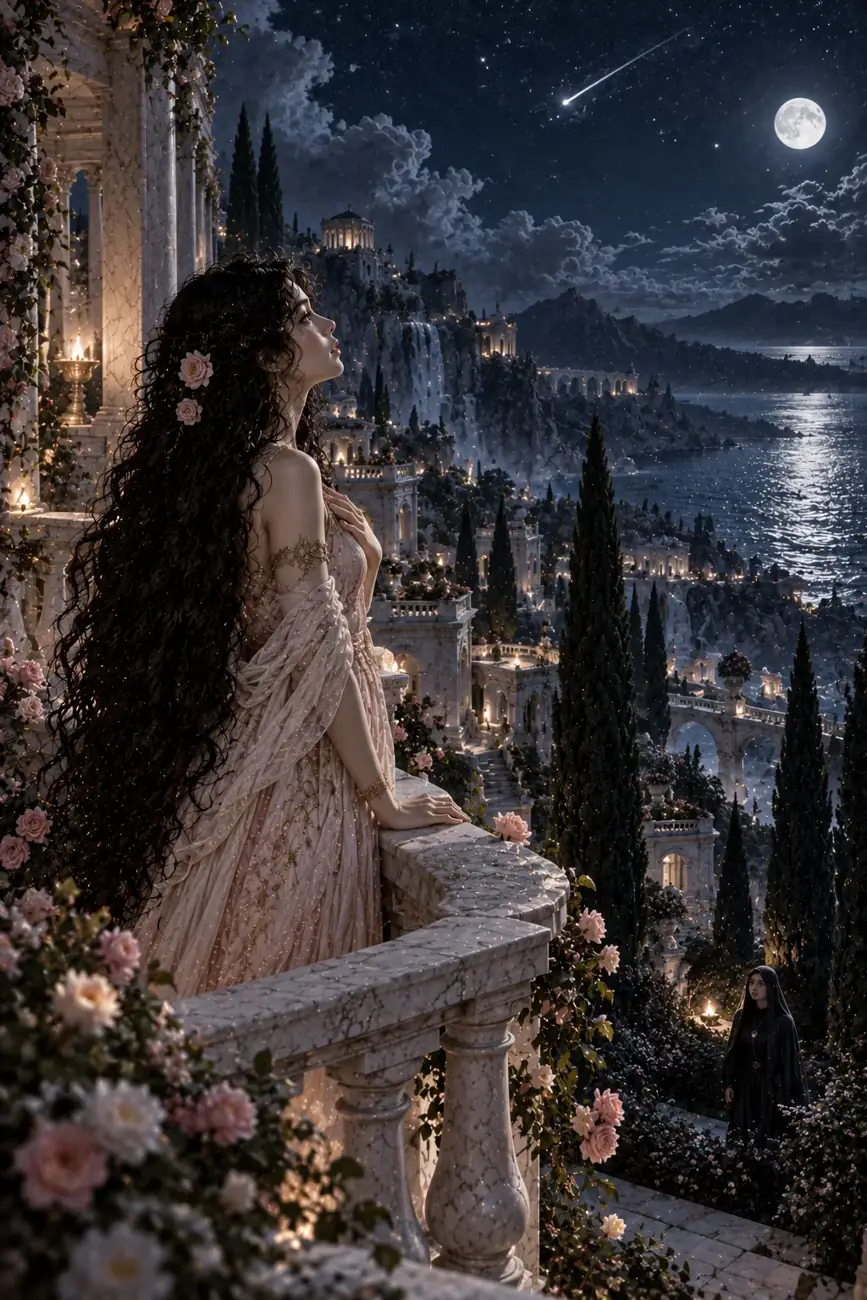
Her voice trembled, but the promise did not.
“I do not know where you are. I do not know what this world will ask of me, or what I will have to become to reach you. But I will find you.”
The stars gave no answer.
She did not need one.
Behind her, the palace held its sleeping family, its servants, its duties, and the life she had promised herself to protect. Somewhere beyond the gardens, the veiled woman might still be watching. Tomorrow would bring more questions, more ceremonies, and more chances for Nila to betray herself with a misplaced word or an unfamiliar gesture.
She would face them.
She would learn to be Aphrodite without forgetting that she was Nila. She would honour the people who trusted her without pretending that their goddess had never existed. She would let herself love this strange, beautiful world, but she would not mistake it for the reason she had crossed the Gate.
Her purpose was still out there, beneath another sky.
She remained on the balcony until the tears dried and the stars settled into stillness. Only then did she turn back towards the room, carrying the duty of Aphrodite in one hand and the promise to Ray in the other.
The veiled woman stood far below in the shadow of a cypress tree.
She had watched Aphrodite through the day. She had seen the hesitation, the unfamiliar kindness, the moments when the goddess seemed to be discovering her own city for the first time. She had seen her stand beneath the stars and speak a name no one in Olympus had ever heard.
The woman’s expression remained unreadable.
Then she turned away and disappeared into the dark.
Nila did not see her.
She was looking at the stars, and somewhere beyond them, she believed, Ray was waiting.
By her fourth morning in Olympus, when the palace bells rang for the morning audience, Nila had learned that being Aphrodite was not a matter of wearing a beautiful face. The face opened doors. The name made people bow. The power beneath the name carried obligations that did not disappear simply because the woman inside it was frightened.
She stood before the tall mirror while Mara arranged the folds of a pale rose-coloured gown. Sunlight poured through the open balcony doors and touched the gold thread at the sleeves. Beyond the room, Olympus glimmered with impossible clarity: marble terraces, green gardens, fountains that caught the light like scattered glass, and distant roofs shining above the clouds.
Nila loved it. That was the part that frightened her most.
She loved the clean air, the way the morning seemed to have been washed before it reached the palace, the birds that flew between the columns without fear, and the roses that climbed the walls as if they had chosen to live there. Even the sound of the servants moving through the corridors felt gentle. She wanted to explore every staircase, every garden, every path that curved towards the mountains. She wanted to ask a hundred questions and hear a hundred stories.
But every time someone called her “my lady” or “Aphrodite,” the wonder was followed by a sharp pinch of guilt.
This place belonged to someone. These people loved someone. Dorian had looked at her with the easy intimacy of a husband who knew the small habits of his wife. Melia had studied her with a daughter’s quiet attention. Phaon had run into her arms without a moment’s hesitation. They were not props in a story or characters from a book. They were living people who trusted the goddess they knew.
And Nila was wearing her life.
“You are pulling at the sleeve again,” Mara observed.
Nila stopped. “Am I?”
“You have done it three times. The gown is not trying to escape you.”
The remark was so ordinary that Nila nearly laughed. “I am trying to remember whether I have worn it before.”
Mara’s hands paused at her shoulder. “You wore it at the spring offering last year. You said the colour made you look like a rose that had decided to become a queen.”
Nila’s stomach tightened. “That sounds like something I might say.”
“It is exactly something you would say.” Mara resumed fastening the clasp. “You have been strange since you woke, my lady. Not unkind. Just... elsewhere.”
Nila met her own eyes in the mirror. “I did not sleep well.”
It was a small lie, but it carried the weight of all the others she might have to tell.
Lyra stood near the balcony, arranging white blossoms in a shallow bowl. She had been unusually quiet since the first moment she entered Nila’s room. Every so often, Nila caught her watching, not with suspicion exactly, but with the attentive curiosity of someone noticing a familiar melody played in the wrong key.
When Mara finally stepped away to fetch the ceremonial sash, Nila turned towards the younger servant.
“Lyra, will you walk with me today?”
The girl blinked. “Of course, my lady.”
“Not behind me. Beside me.”
For the first time that morning, Lyra looked genuinely startled. Then a small, uncertain smile appeared. “If that is what you wish.”
“It is.” Nila glanced towards the balcony. “I would like to see more of Olympus before the ceremony.”
“You have seen most of it.”
“Then show me the parts I have forgotten.”
Lyra’s expression softened, but her eyes lingered on Nila’s face as though the words had confirmed something she had been afraid to name.
The lower temple stood at the heart of a wide square, its pale columns wrapped in garlands of roses and myrtle. Music drifted between the buildings. Vendors had arranged baskets of figs, honey cakes, and bright ribbons beneath awnings, while children chased one another around the fountain at the centre of the square.
When Nila stepped from the carriage, the noise of the crowd changed. Conversations softened. People turned. Some bowed their heads; others reached for the hands of their children and guided them closer. A few looked at her with such naked hope that Nila felt the responsibility of the name settle across her shoulders.
They had not come to admire a beautiful face. They had come because they believed she could help them with the most vulnerable parts of their lives.
The first petition came from a young woman named Thalia. She wore a plain blue dress and held its hem so tightly that her knuckles had turned pale. Her family had arranged a marriage for her, and she was afraid to tell them she did not love the man they had chosen.
“I was told you could make a heart turn,” Thalia said. “Could you make my father understand?”
Nila felt every eye on her. The stories said Aphrodite could inspire desire, bind lovers together, and turn longing into a force that changed kingdoms. Yet she knew what it meant to be frightened of disappointing the people who believed they knew what was best for you.
“I cannot promise that your father will understand today,” she said. “And I will not make another person love you or obey you. But I can tell you this: your life is not a gift someone else gets to give away. You deserve to be heard before anyone decides your future.”
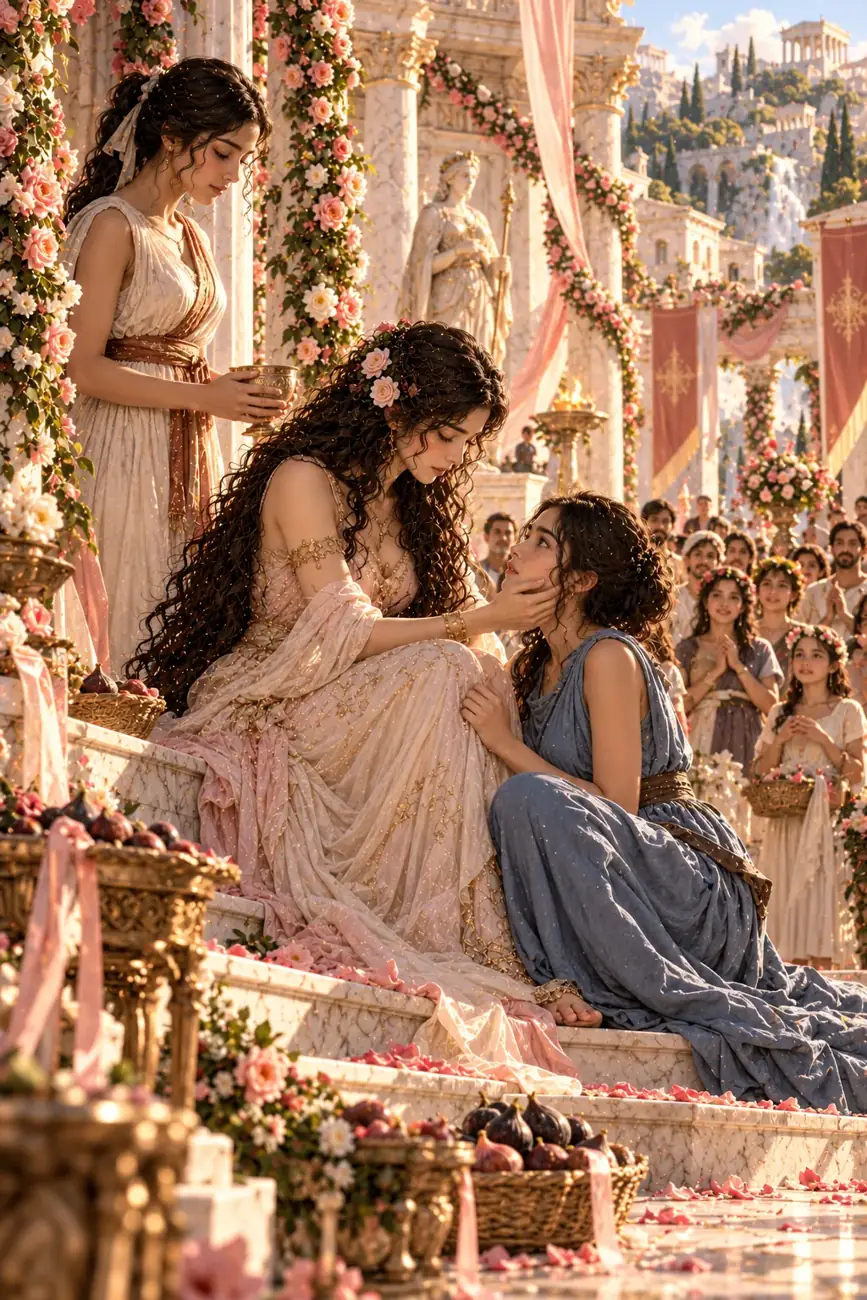
Thalia looked up. “What if he refuses?”
“Then we will think about what you can do next. You do not have to solve the rest of your life before sunset.”
The young woman’s fingers loosened around her dress. It was not a miracle. Nila had no magic answer to offer her. But when Thalia stepped away, she carried herself a little more steadily.
The next petitioner was an old man who wanted Aphrodite to make his daughter forgive him. He described an argument that had lasted for years and asked for a divine command that would erase it.
“If she forgives you because I order her to, will that be the forgiveness you want?” Nila asked.
The man frowned. “I want my daughter back.”
“Then perhaps begin by telling her what you regret, without asking her to comfort you for it.”
He looked offended at first. Then, slowly, his expression changed. He lowered his head and left without another word.
There were more petitions. A young couple who had stopped speaking because neither wished to apologise first. A widow who wanted to know whether loving her husband after his death meant she had failed to move on. A boy who believed a girl had laughed at him and wanted Aphrodite to make her regret it.
Nila listened to every one of them.
At first, she was afraid of saying the wrong thing. She worried that the real Aphrodite might have answered with a gesture, a blessing, or a power Nila could not summon. But as the hours passed, she began to understand that the goddess’s duty was not simply to create love. It was to stand near people when love made them brave, foolish, generous, selfish, hopeful, or afraid.
She could not command every heart. She could, at least, refuse to treat one as a toy.
That thought gave her enough courage to continue.
During a pause in the ceremony, Lyra brought her a cup of water. “You have been listening to them as if every word matters.”
“Does it not?”
“Sometimes people come here wanting a miracle, not advice.”
“Perhaps advice is the only miracle I know how to give.”
Lyra looked at her for a long moment. “That is not what you usually say.”
Nila’s hand tightened around the cup. “What do I usually say?”
“You tell them the heart is a wild thing. That it cannot be owned, only invited.” Lyra tilted her head. “You once told a prince that if he wanted a woman to love him, he should stop sending her jewels and start listening when she spoke.”
Despite herself, Nila smiled. “That sounds like good advice.”
“It was. He hated it.”
They shared a brief laugh, and for a moment Nila felt something loosen inside her. She was not Aphrodite, but perhaps she could carry some of the goddess’s kindness without pretending to own her whole life.
Then she saw the woman in the veil.
The stranger stood beneath a cypress tree on the far side of the square. Her clothes were dark and simple, out of place among the festival colours. A veil concealed most of her face, yet Nila felt the force of her attention as clearly as if the woman had spoken her name.
Nila turned fully towards her.
The woman did not bow. She did not look away. She watched Nila with the stillness of someone waiting for a door to open.
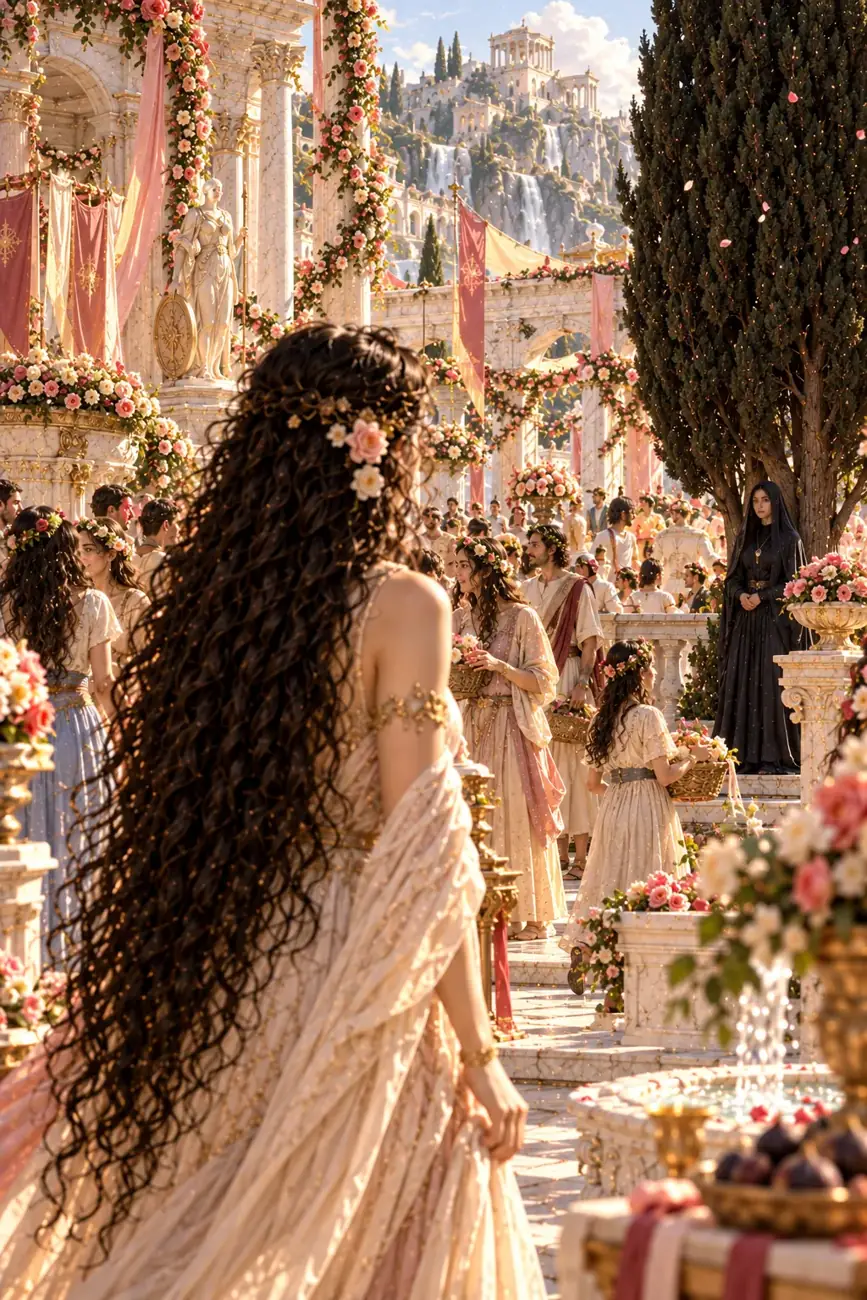
A vendor crossed between them carrying a tray of fruit. When he passed, the woman had disappeared.
“Did you see her?” Nila asked.
Lyra followed her gaze. “See whom?”
“A woman beneath the cypress. Dark veil. She was watching me.”
Lyra’s face changed so quickly that Nila almost missed it. A flicker of recognition. Then worry. Then a carefully arranged blankness.
“There are many people watching you today, my lady.”
“Not like that.”
Lyra lowered her eyes. “You should come inside. The next part of the offering is ready.”
Nila allowed herself to be guided towards the temple, but the stranger’s gaze seemed to follow her beneath the stone archway.
The ceremony lasted longer than Nila expected. She stood beneath the temple’s open roof while priests brought forward bowls of oil, baskets of flowers, and small offerings left by families who wanted blessings for their homes. The words of the ritual were familiar from books, yet hearing them spoken by people who believed in them changed their weight.
She repeated the lines when the priest signalled for her to speak. She placed a rose upon the altar. She accepted the petitions and gave what comfort she could.
No one questioned her.
That should have relieved her. Instead, every smooth moment deepened her guilt. Her performance was convincing because everyone wanted Aphrodite to be there. They saw what they expected to see, and Nila was learning how to give it to them.
When the final blessing was spoken, the crowd bowed. Nila lifted her hand in response, and the gesture felt more natural than it should have.
For one frightening second, she wondered whether she was becoming good at this because she was losing herself.
Dorian met her at the temple steps. He had waited beneath the shade of a marble portico, speaking quietly with one of the attendants. When he saw her, his expression warmed with affection and relief.
“You were patient today,” he said as they walked towards the carriage. “More patient than you have been in weeks.”
Nila searched his face for suspicion. She found only a husband pleased to see a gentler side of the woman he loved.
“Was I not patient before?”
“You were. But lately, you have carried every sorrow in Olympus as if it were yours alone to repair.” He offered her his arm. “Today you allowed people to leave with their own decisions.”
“Perhaps they needed that.”
“Perhaps I did too.” He smiled at her. “You have been reminding me that love cannot be forced for years. I should have learned by now.”
His familiarity hurt more than suspicion would have. He spoke of shared years, private arguments, small jokes, and promises she had never made. Nila could only listen and try not to let her face reveal the grief of being a stranger inside someone else’s happiness.
“I am glad you are feeling better,” Dorian said.
She looked at him. “So am I.”
It was the truth, though not the one he heard.
At home, Melia asked whether the offering had gone well. She listened carefully as Nila described the people who had come to the temple, then asked a question that made Nila pause.
“Do you think love makes people better, Mother?”
Nila sat beside her daughter. “Not by itself. Love can make people brave, but it can also make them afraid. It can help people grow, or give them an excuse to hold on too tightly. What matters is what we choose to do with it.”
Melia considered the answer. “That sounds more difficult than the stories.”
“It is.” Nila brushed a strand of hair away from her daughter’s face. “Stories sometimes make the difficult things beautiful so we can bear to look at them.”
Melia leaned against her shoulder, accepting the answer for now.
Phaon arrived carrying a garland that had come apart in his hands. He looked devastated. Nila helped him thread the flowers together again, and when he accidentally tied a knot around his own finger, he laughed so hard that Dorian had to turn away to hide his smile.
For a little while, Nila forgot to be afraid.
She loved the warmth of the room, the sound of the children arguing over the last honey cake, and the way Dorian listened when Melia spoke. She loved this family’s ordinary happiness. The feeling was not borrowed from Aphrodite. It rose from Nila herself, and that made the guilt sharper.
She could not stay forever. She could not let the people in this house become a substitute for the person she had crossed a universe to find.
But until she found a way to reach Ray, she had a duty here. The people of Olympus deserved more than a frightened stranger hiding behind their goddess’s face.
She would do the work. She would learn the customs, answer the petitions, and protect the people who trusted her. She would be Aphrodite as honestly as she could, without forgetting that she was Nila.
That evening, Nila returned to her rooms with tired feet and a mind that would not settle. The veiled woman had appeared twice more during the day: once near the temple steps, and once across the courtyard outside the family apartments. Each time she stood at a distance. Each time, she vanished before Nila could reach her.
The woman was not simply watching Aphrodite. She was watching Nila.
Nila waited until Mara had gone and the palace corridors grew quiet. Lyra was gathering the last of the flowers from the room when Nila spoke.
“Please stay.”
Lyra turned. “Of course, my lady.”
“And close the door.”
The girl obeyed. When she turned back, Nila was standing beside the balcony doors, her hands clasped so tightly that her fingers had begun to ache.
“There is something I have tried to say,” Nila whispered. “But I cannot find a way to say it without sounding foolish.”
Lyra set down the folded linen. “You have frightened me these past few days, my lady. Not because you have been cruel. Because you look at your own home as though you are lost inside it.”
“Sometimes I feel that I woke in a life that belongs to someone else.”
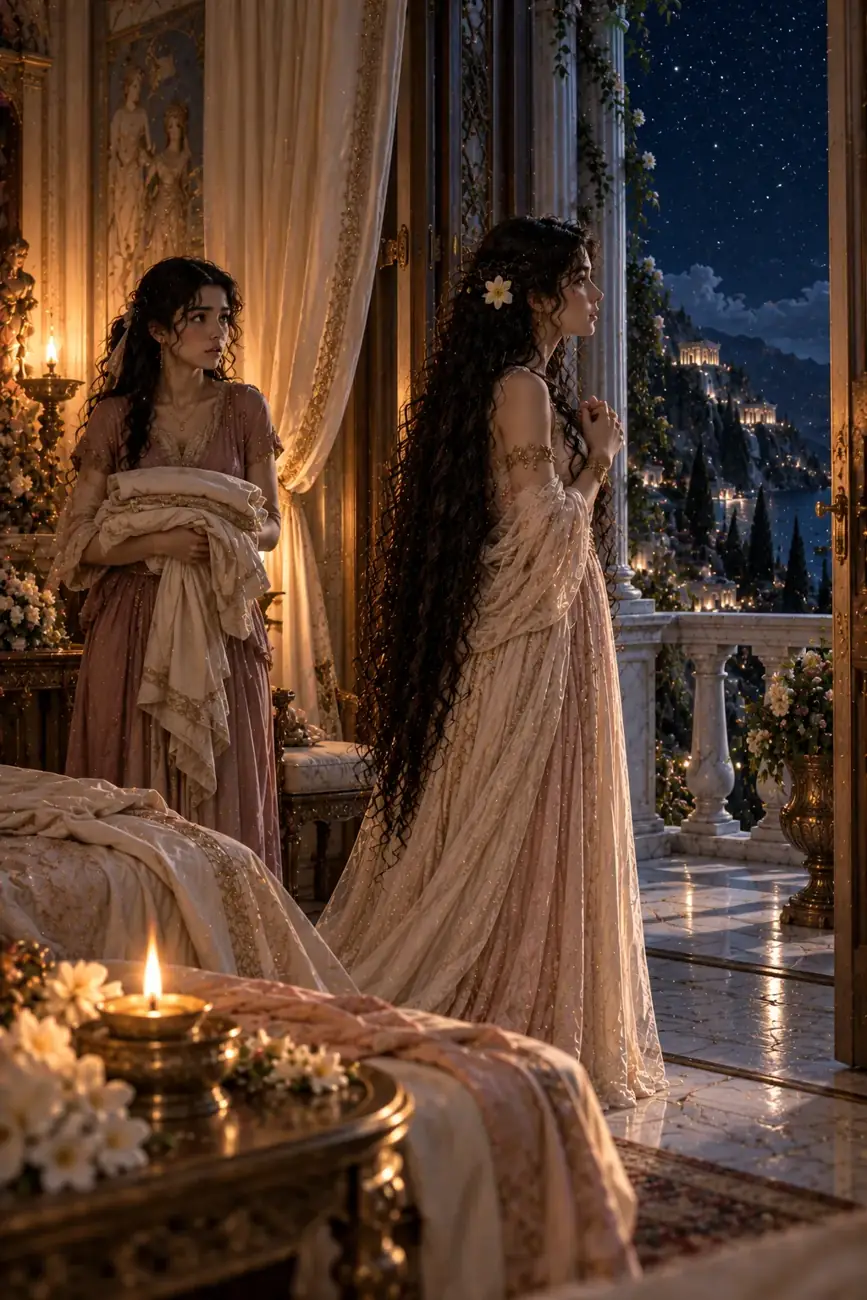
Lyra went still. “You have been unwell?”
Nila stared past the balcony. “There was another place. A room full of lights. People who studied the stars. And someone I loved. His name was Ray.”
“A dream?” Lyra asked gently.
“No. I wish it were. He went somewhere I could not follow, and then I tried to reach him. I thought I would find him when I woke.” Nila looked at her hands. “Instead I found this palace.”
Lyra approached with the caution one might use beside someone recovering from a terrible fever. “You are Aphrodite,” she said. “You have lived here longer than I have been alive. Perhaps something happened to your memories.”
“You think I have forgotten who I am.”
“I think you are suffering,” Lyra said. “And I think you should not have to suffer alone.”
Nila almost told her everything then: the laboratory, the machine, the Gate, the choice she had made. But Lyra’s worried eyes stopped her. If she said more, the girl might summon a physician, a priest, or Dorian. Nila could not risk that yet.
“Please do not tell anyone what I said.”
Lyra hesitated. “Not unless I believe you are in danger.”
“I am not asking you to believe me. Just give me time.”
Lyra nodded, though the fear in her face remained. She still saw her goddess standing before her, wounded by some invisible illness. Nila saw that clearly and knew she had not been understood.
“You have been asking about the old roads and the mountains,” Lyra said after a while. “Is that because of this man you remember?”
“Yes.”
“Then there is something I should tell you.”
Nila turned toward her, suddenly alert.
Her voice had changed. The softness remained, but beneath it lay shame.
Nila waited.
“The woman in the veil sent me to watch you.”
For a moment, Nila did not understand the sentence.
“What?”
Lyra looked down at her hands. “She approached me before you woke. She knew I served you. She told me to pay attention to anything unusual and report what I saw. She said it was important that she know whether Aphrodite had changed.”
The room seemed to tilt around Nila.
“You were spying on me.”
“Yes.” Lyra’s eyes shone. “At first, I thought she was protecting you. She knew things about the old temples and the gods that ordinary people do not know. She said she had reasons to fear what might happen if you were not yourself. I was curious, and I wanted to help. I told myself I was only keeping watch.”
“And what did you report?”
“That you were asking questions. That you seemed afraid. That you listened to the people who came to the temple as if you were learning how to be kind.” Lyra lifted her face. “I did not tell her about this. I swear it.”
Nila stepped away. The betrayal stung, though some part of her had already suspected that the veiled woman had eyes inside the palace. She had trusted Lyra because the girl’s kindness felt real. Now she did not know whether that kindness had been genuine or merely another part of the watch being kept around her.
“Why tell me now?”
“Because I understand now that she did not send me to protect you.” Lyra’s voice trembled. “She sent me because she wanted to know what you were. And because you trusted me enough to tell me the truth, I cannot keep using that trust against you.”
“You could still betray me.”
“I could.” Lyra did not look away. “You have no reason to believe me. I know that.”
The answer was so honest that Nila had no immediate reply.
Lyra stood and wiped her cheeks with the heel of her hand. “I am young, my lady. I do not know how to open a gate between worlds. I do not know how to reach a man lost somewhere beyond the edge of every map I know. I barely understand what you have told me. But I know one person who may be able to help you.”
Nila felt hope rise, sudden and dangerous.
“Who?”
Lyra hesitated, glancing towards the door as if the walls might be listening.
“Someone who knows the old paths. Someone who has studied prayers that were forbidden long before I was born. She can speak of doors the gods closed and places the temples pretend never existed.”
“The woman in the veil?”
“Yes.”
Nila’s hope faltered. “Why would she help me if she sent you to spy on me?”
“I do not know what she wants from you. I do not know whether she can be trusted. But I think she is looking for something too, and she believes you may be the answer to a question she has carried for a very long time.”
“Then she is using me.”
“Perhaps.” Lyra took a step closer. “But if she knows a way to reach Ray, would you refuse to hear her?”
Nila looked out towards the darkening sky. The first stars were appearing above the mountains. She had spent the day answering the hopes of strangers, carrying a goddess’s responsibilities, and trying not to let the family in this palace see how frightened she was. She had done it because it was the right thing to do, and because the people of Olympus deserved care even from someone who had arrived here by accident.
Now, for the first time since crossing the Gate, there was a possible path forward.
It might be dangerous. It might be a trap. It might lead nowhere at all.
But it was a path.
“I will meet her,” Nila said. “Not because I trust her. Because I need to know what she knows.”
Lyra nodded, relief and fear mingling in her face. “I will help you. I cannot promise I will make everything right, but I will not let you face her alone.”
Nila studied the young servant. She still could not know whether the girl’s loyalty would survive the danger ahead. Trust, she was learning, was not a door that opened once and stayed open. It was a choice made again each time the truth became difficult.
“Thank you,” she whispered.
Lyra reached for the bowl of flowers and set it between them, an ordinary gesture that gave them both something to look at while the room settled around their confession.
Outside, far beyond the palace, the veiled woman stood beneath the cypress trees. She had seen Lyra enter the goddess’s rooms and had watched the light remain beneath the door long after the servants’ corridor had emptied.
She did not know what had been said inside.
But for the first time in many years, she suspected that Aphrodite might be the one who came looking for her.
And Nila, standing beside a young servant who had begun as a spy and chosen to become an ally, felt the first fragile shape of hope.
The Black Fortress had been built to make visitors feel small. Its gates rose higher than the watchtowers of the Cinder Flats, and its corridors were carved from dark stone that swallowed the light instead of reflecting it. Black banners hung between the pillars. Their edges were singed from old wars, and the floor beneath them had been polished by generations of boots marching towards the throne.
Lucifer walked through the fortress without an escort. Soldiers moved out of his path before he reached them. Servants lowered their eyes. No one asked why he had returned from the battle with ash in his hair and a strange, almost boyish wonder still lingering beneath his terrible expression. They had seen him fly. They had heard his roar shake the flats. They were trying to decide whether the king had become stronger or whether something had finally awakened inside him.
In the council chamber, a long map covered the table. Seven realms were marked in ink and stone: the Black Dominion, the Ashen March, the Kingdom of Thorns, the Drowned Kingdom, the Glass Wastes, the Iron Deep, and the Silent Vale. Some borders were drawn in gold, others in red. Red meant the border had been settled by blood.
Malrec, the king’s adviser, stood beside the map. He was a narrow man with silver threaded through his hair and a voice that rarely rose above a quiet murmur. He had survived three kings and served Lucifer longer than most people in the fortress had been alive. He bowed when Lucifer entered, but he watched the king’s face carefully.
“Tell me what I rule,” Lucifer said.
Malrec glanced at the map. “The Black Dominion directly. The other realms through tribute, treaty, and the fear of what happens when they refuse.”
“That sounds less like ruling and more like keeping everyone frightened enough to behave.”
“Fear is reliable, my lord. Gratitude is not.”
Lucifer studied him. “Is that what you believe, or what you have learned to tell me?”
For the first time, Malrec seemed uncertain. “In this court, the distinction has rarely mattered.”
The answer should have angered Lucifer. Instead, it interested him. He asked about the battle, the prisoners, and the villages burned during the western advance. Malrec explained that the Ashen March had supplied the enemy with horses and grain. Some villages had done so willingly. Others had been caught between armies and given no choice. Lucifer listened until the adviser finished, then asked for the prisoners to be released and food sent to every settlement damaged by the fighting.
The council reacted as if he had ordered the fortress dismantled. Lord Varric, a broad-shouldered commander with a scar across his scalp, struck the table with his palm.
“They will mistake mercy for weakness.”
“Then let them make the mistake,” Lucifer replied.
“Your enemies will gather again.”
“They were going to gather again whether I fed their children or starved them.” He leaned over the map. “I can keep winning battles. I want to know what happens after I win them.”
No one had an answer. They had all been trained to preserve the machine of fear, not imagine a world that did not require it.
The order was carried out, but not willingly. A guard captain refused to escort the prisoners and resigned his commission. Two couriers delayed the food wagons. A local lord sent back the relief grain with a note claiming that accepting it would be an admission of submission. By evening, Lucifer had learned that giving a merciful order was easier than making a frightened kingdom believe it.
That night, he stood alone at the high window of his chambers. The glass reflected his wings as two torn shadows. He disliked the face that looked back at him, but he no longer felt the same resentment he had felt beside the stream. The face was merely a vessel. The power inside it was real.
A small image flickered behind his eyes: a white room, a tiny machine with a screen, a yellow flower opening against darkness. A woman’s voice seemed to speak, but he could not make out the words. He pressed his fingers to the glass until the image vanished.
“Not now,” he said to the reflection.
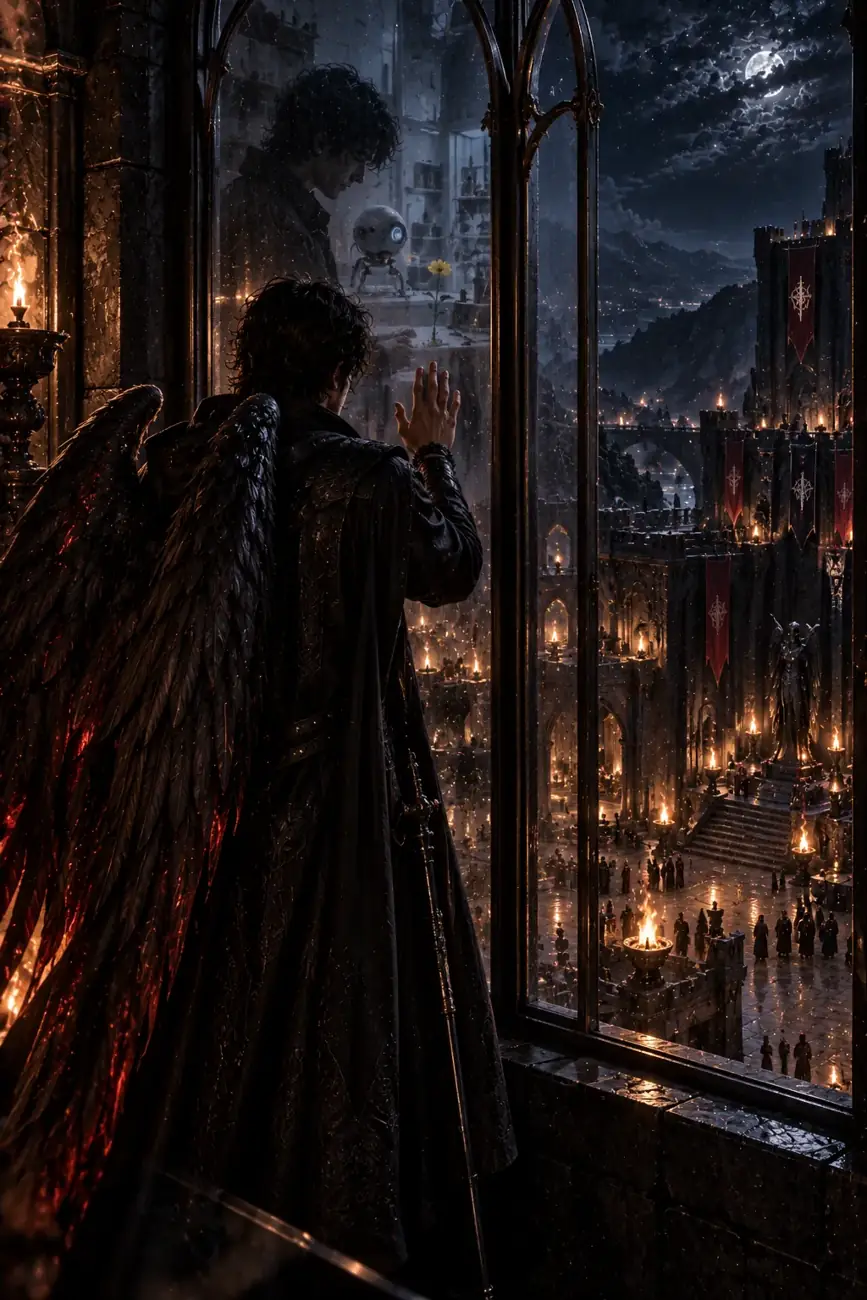
He had a kingdom to understand. He had people who depended on him, enemies who wanted him dead, and power that frightened even the men who served him. He would not let an invisible memory command him.
Far below, the fortress bells rang the hour. In the courtyard, soldiers spoke quietly about their king. Some said the battle had changed him. Others said he had always been this way and had simply stopped pretending. No one knew that the ruler they feared was still trying to discover the man who had existed before his wings.
The days in Olympus acquired a rhythm, and Nila began to recognise the rhythm before she recognised herself within it. There were morning offerings, petitions brought to the temple, meals that could not be missed, and small ceremonies whose importance became clear only when she saw how carefully everyone prepared for them. Aphrodite’s life was not an endless procession of beauty. It was a thousand obligations, each one attached to somebody else’s hope.
Nila tried to meet those obligations with care. She learned which prayers were spoken at weddings, which flowers were laid before the altar when a marriage was in danger, and which promises should never be made on behalf of another person’s heart. She could not command people to love one another. She could listen, offer counsel, and remind them that love without choice was only possession wearing a pretty name.
The work unsettled her in ways she had not expected. She had entered Olympus to find Ray, yet the people who came to Aphrodite did not know that. They brought their grief to her because they believed she was the goddess who understood it. Their faith made her feel like an impostor. Their need made it impossible to walk away.
One afternoon, Melia asked Nila to walk with her through the rose garden. The girl carried a basket and stopped every few steps to inspect a flower, rejecting one for being too pale and another for having a damaged petal. Nila watched her with a fondness that surprised her.
“You take this very seriously,” Nila said.
“The flowers are for the fountain ceremony. Father says the arrangement matters.”
“And what do you think?”
Melia held up a rose whose petals were uneven. “I think this one should go in the middle. Everyone will see the perfect ones first. This one deserves to be seen too.”
Nila looked at the flower and felt a small ache move through her. “Then the middle is exactly where it belongs.”
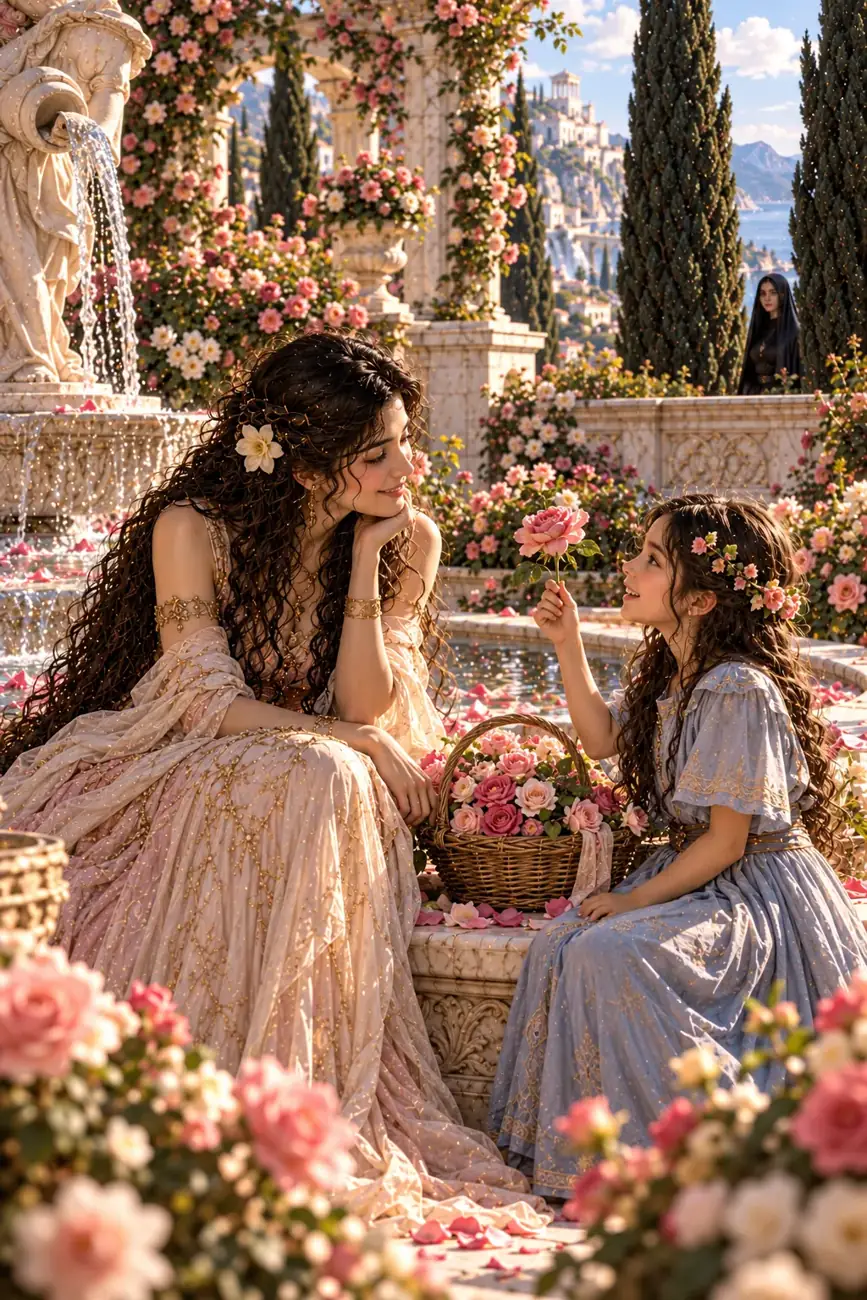
They sat beside the fountain. Melia spoke about the mountains beyond Olympus and how she wanted to travel there one day. She asked whether her mother had ever wished to leave the palace.
Nila chose her answer carefully. “Sometimes I think about someone who is far away.”
“Would you bring him here?”
“Only if he wanted to come.”
Melia studied her face, too young to hide her curiosity. “You look sad when you say that.”
“I can be happy here and still miss someone.”
“Is that how love works?”
Nila smiled, though her throat tightened. “I think that is one of the ways.”
The moment was interrupted by a movement beyond the garden wall. A woman stood between two cypress trees, dressed in plain dark cloth that seemed almost colourless beside the roses. Her face was covered by a light veil. She was not looking at Melia or the garden. She was watching Nila.
Nila rose. “Wait here.”
She crossed the path and went through the small side gate, but by the time she reached the cypress trees, the woman had disappeared. On the stone wall lay a dried rose tied with black thread. A broken circle had been carved into its stem.
Lyra, who had followed at a distance, went pale when she saw it.
“You know what this means,” Nila said.
Lyra picked up the rose without touching the thread. “I know who uses that mark.”
“Who?”
“A priestess who was told to leave Olympus and never return.”
“Why is she following me?”
Lyra looked towards the palace. “Because she thinks you are still the Aphrodite she remembers.”
Nila heard the careful choice of words. “And what do you think?”
The young servant lowered her eyes. “I think you are trying very hard to be someone you are not.”
For one terrible second, Nila thought Lyra would call the guards. Instead, Lyra wrapped the rose in a scrap of cloth and placed it inside her sleeve.
“Not here,” she whispered. “There are ears in the garden. Come inside, and I will tell you what I can.”
Lyra did not tell Nila the whole story at once. She waited until the household had settled, then led her through a narrow passage behind the linen rooms to a small terrace where servants went to be alone. The night smelled of rosemary and warm stone. Below them, the lamps of Olympus shimmered along the hills, beautiful enough to make the world seem incapable of cruelty.
“Her name is Selene,” Lyra said. “She was a priestess at a sanctuary beyond the olive groves. People went to her when love became grief, when promises broke, or when the gods seemed to have stopped listening.”
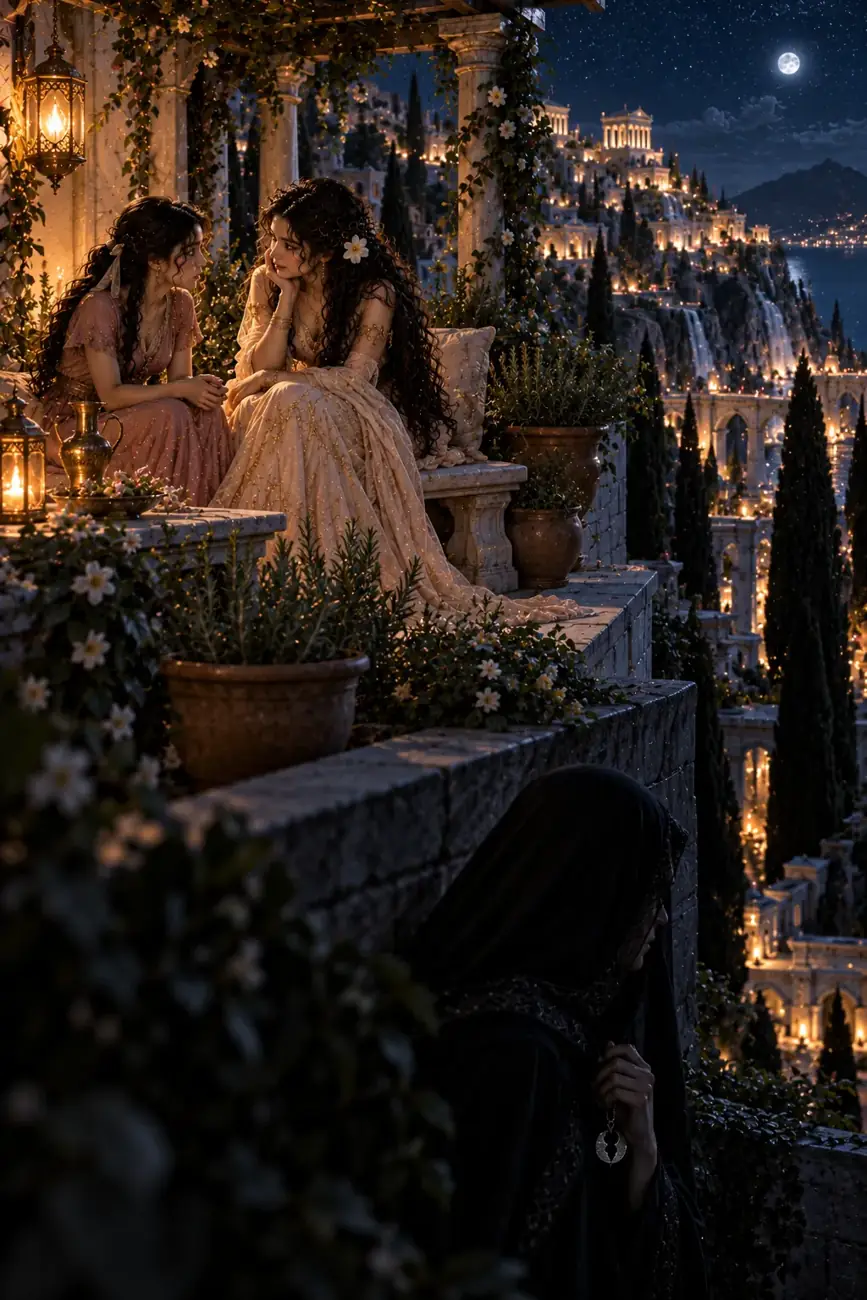
“What happened to her?”
“A sickness came through the valley. Her younger sister was dying. Selene begged Aphrodite to intervene, but a divine decree forbade carrying the sickness into the nearby city. Aphrodite refused to break it. The city survived. Her sister did not.”
Nila looked towards the dark hills. “Aphrodite did not cause the sickness.”
“No. But she had power, and Selene believes she chose a rule over a person.”
“Was there truly no other way?”
“Aphrodite believed there was not. Selene has spent years believing there must have been.”
Nila understood the wound beneath the anger. It was not proof that Selene was right about everything. It was proof that grief could live for years inside a question no answer could make harmless. She could understand the priestess without promising to become her weapon.
“Why did you spy on me for her?” Nila asked. “You already told me she sent you. What did she hope you would discover?”
Lyra twisted her fingers together. “She thought something had changed in you. I thought you had fallen ill. Even when you spoke of a man named Ray and a room full of lights, I thought they were memories broken by fever.” She swallowed. “But Selene knows of passages the gods erased from their histories. She has described places beyond Olympus. When you spoke of another place, I began to wonder.”
“You still believe I am Aphrodite.”
“I did,” Lyra admitted. “I wanted to. Tell me what you could not tell me that night.”
Nila listened for footsteps in the passage. “I did not dream that room, Lyra. It exists. It is on Earth, a world where people study the universe with instruments rather than prayers. We called our work Project Omnia. We built a machine called the Omnia Gate to reach another universe. Ray entered it first. The Gate carried him into Veyrath, into the life of the one you call Lucifer. I followed him. I chose Aphrodite, and I woke here.”
Lyra stepped backward until the stone bench caught her legs. “Lucifer?” she breathed. “The king of the fallen? You are saying he was a man from your world?”
“He is the man I love. I do not know whether he remembers me. I do not know what this world has done to him. But I know why I came.”
“And you truly are not...” Lyra could not finish. Her gaze moved over Nila’s face, searching for the goddess she had served all her life. “All those questions you asked. The way you looked at Melia and Phaon as though you were meeting them for the first time. You were.”
“Yes.” Nila held her gaze. “I told you only fragments before because you thought I was ill, and I was afraid you would call someone to stop me. I am telling you all of it now because I need you to choose with your eyes open.” Lyra’s breath shook. “I do not understand the machine,” she said. “But I understand what you have risked. And I believe you.”
“Then help me find Selene.”
Lyra nodded, though fear still tightened her face. “She has studied the old paths between realms for years. She believes a road once connected Olympus and Veyrath. The gods sealed it and called it a legend. Selene thinks she can open it.”
“Then she may be able to help me reach Ray.”
“She will ask something of you.”
“I know. I will listen. But I will not help her hurt innocent people.”
Lyra took a shaky breath. “I will take you to her. I cannot promise the gods will forgive me, and I cannot promise Selene is safe. I only promise I will not send you there blind.”
Far below the terrace, beyond the cypress trees, the veiled woman stood in shadow. She had heard only fragments, but one word had reached her clearly: Veyrath. Her fingers closed around a silver pendant shaped like a broken circle. “A door between worlds,” Selene whispered. “After all these years.”
Nila waited until the next evening. She carried out Aphrodite’s duties through the day, hearing petitions and sitting beside Dorian while three families argued over a marriage alliance. She listened carefully, offered counsel, and gave no one reason to suspect that her thoughts had already crossed the mountains. The people who came to her were not symbols in a story. They were frightened, hopeful, difficult, and real. She could not abandon them carelessly, even for Ray.
When the palace lamps were lit, Lyra brought a plain cloak and a small satchel. Her hands fumbled with the clasp twice before she managed to fasten it.
“You are shaking,” Nila said.
“I am trying not to.” Lyra glanced towards the corridor. “If the guards discover I helped you leave, they will ask questions. If the gods discover what Selene intends, questions will be the least of our troubles.”
“You can still stay here.”
“And let you walk into this alone? No.” Lyra tried to smile, but it did not hold. “I am frightened, Nila. I need you to know that. I have never seen a gate between worlds. I do not know what might come through it.”
They left through a service gate and followed a path between olive trees. The city’s sounds fell away behind them. The sanctuary stood on a hillside where the earth had split around old foundations. Its roof had collapsed, and vines covered the pillars. No birds nested there. Even the wind seemed to avoid the broken altar.
Selene waited in the centre of the ruins. She had laid three old stones in a triangle and covered the altar with a dark cloth. A bowl of black water sat in the middle. Beside it lay a narrow silver blade, a spool of red thread, and a small clay vessel whose surface was marked with symbols almost worn smooth.
“You came,” Selene said.
“I need to reach Veyrath.” Nila looked at the bowl. “Tell me exactly what this will do.”
“It will tear a seam in the boundary. Not a door built for people to pass through. A wound that may hold open long enough for one crossing.” Selene’s eyes moved between Nila and Lyra. “I have never opened it. I have only found the words and the remnants of the old rite.”
Lyra took a step back. “You said you knew how.”
“I know how to attempt it,” Selene replied. “That is not the same as knowing what will happen.”
“You should have told us that before we came,” Lyra said, her voice rising. “What if it opens into something else? What if something comes through from the other side? What if it does not close?”
Selene did not look away. “Those are the questions I have been asking myself for years.”
Nila felt the cold of the night gather under her cloak. “Then why do it?”
“Because the old road is real, and because you are the first person I have met who may cross it without belonging wholly to either side. Your mind comes from Earth. Your body carries Aphrodite’s divine nature. The boundary may recognise you as both an intruder and a key.”
“And what do you want in return?”
“When you return, you will help me bring my sister’s story before the gods. I want them to hear what their decree cost. I want Aphrodite to acknowledge that a choice may be necessary and still leave a wound.” Selene’s jaw tightened. “I do not ask you to call her evil. I ask you not to let the gods call the matter finished simply because the city survived.”
“I agree to tell them what happened,” Nila said. “I cannot promise they will listen. And I will not help you harm anyone to force them.”
“Then we have a treaty.” Selene held out her hand. “I open the passage. You carry my sister’s truth to Olympus. Neither of us uses the other’s grief as a weapon.”
Nila took her hand. Selene’s fingers were cold as stone.
The ritual began after midnight. Selene wound red thread around the three stones, then drew the silver blade across her palm. A single drop fell into the black water. It did not spread. It sank like a star disappearing into a well.
The water went still. Too still. The reflections of the stars vanished, one by one, until the bowl held only darkness.
Selene began to speak in a language Nila could not understand. The stones shuddered. A low vibration passed through the ground and climbed Nila’s bones. The old pillars groaned as if something enormous had leaned against them from the other side.
Lyra backed towards the broken arch. “Selene. Stop. The air is moving the wrong way.”
Wind rushed inward from every side. The flames of the candles bent towards the bowl. The red thread pulled taut and snapped one strand at a time. Beyond the sanctuary, every lamp on the distant hillside flickered out.
Selene’s face had gone pale. “The passage is answering.”
“Answering what?” Lyra cried.
“I do not know.” Selene seized Nila’s wrist. “Listen carefully. Once this opens, every god in Olympus may feel it. Not just Aphrodite’s family. All of them. The old seals will know they have been broken. If they trace the breach to this sanctuary, they will come. If they come while you are crossing, the gate could close around you. You could be trapped between worlds, or something could use the opening to cross into ours.”
Lyra stared at the bowl. The darkness inside it had begun to rise, not as smoke but as a vertical sheet of night. A sound came from it like distant voices speaking beneath deep water. “Then close it!”
“I cannot close it while it is forming,” Selene said. For the first time, the priestess sounded genuinely afraid. “Once the seam begins, it must either open fully or collapse. I do not know which will happen.”
Nila’s pulse hammered. “How long do I have?”
“Minutes. Perhaps less.” Selene tightened her grip. “You asked what I wanted. Now I must tell you what I fear. I fear the gods will come before you cross. I fear the passage will take more than you. And I fear that if it opens wide, we may not be the only ones looking through it.”
Lyra caught Nila’s free hand. “Please. We can find another way. There must be another way.” Her eyes shone with tears. “I do not want to lose you to a door we cannot understand.”
Nila looked at the opening. Through the shifting dark she glimpsed a red sky, black banners, and the shape of a battlefield. Far away, a winged figure stood amid smoke.
Ray.
The vision buckled. A crack of white light split the bowl, and a shockwave threw dust from the pillars. Somewhere high above them, a bell rang once though no hand had touched it.
Selene looked upward in terror. “They have felt it.”
“The gods?” Lyra whispered.
“All of Olympus, perhaps. We have no more time.” Selene turned to Nila. “Go now. Whatever you find on the other side, remember our treaty. Bring my sister’s truth back. And do not let the king make you forget who you are.”
Nila squeezed Lyra’s hand. “You were brave enough to come.”
“I was terrified enough to come,” Lyra said, crying openly now. “That is not the same thing.”
“Sometimes it is.”
The darkness surged. Nila stepped towards it. The force caught her like a tide and pulled at her clothes, her hair, her breath. She heard Lyra shout her name. She heard Selene’s prayer break into a scream as the stones cracked apart.
Nila did not look back. The passage folded around her, and the sanctuary disappeared.

Weeks after the first battle, the rebels rose again on the Cinder Flats. This time the battle ended beneath a sky the color of old iron.
By the time the last rebel banner fell, the Cinder Flats had become a field of churned mud, broken weapons, and bodies lying where the fighting had left them. Smoke dragged low over the ground. Horses screamed somewhere beyond the ridge. The Black Guard stood in scattered ranks, too exhausted to cheer and too wary to speak in the presence of their king.
Lucifer walked alone through the dead.
Blood darkened the edges of his armour. It marked his boots and streaked the black feathers of his wings where they hung behind him, immense and ragged. His soldiers moved aside before he reached them. Even men who had fought beside him for years lowered their eyes. They feared the silence that came after his victories more than they feared the battle itself.
Captain Caelan Voss approached only when Lucifer stopped beside a fallen standard. “The western lords have surrendered. The survivors are being gathered beyond the ridge.”
“And the prisoners?”
“Disarmed. We have kept them separate from the wounded.” Caelan hesitated. “Some of our men want to make an example of them.”
Lucifer looked down at the blood on his glove. “Then they can learn to obey an order without needing to enjoy it.”
Caelan bowed, but he did not leave. He had learned that the king’s smallest pause could be more dangerous than a shouted command.
“What is it?” Lucifer asked.
“The men are afraid of you, my lord.”
Lucifer turned his head slowly. “They should be afraid of losing.”
“That is not what I meant.”
For a moment, crimson light moved behind Lucifer’s eyes. Caelan lowered his gaze. “No, my lord.” He stepped back before the king could decide whether honesty deserved punishment.
Lucifer climbed the low rise where his commanders had waited during the final assault. From there he could see the whole field. He had won. The border would hold. The rebels would not challenge him again soon. Yet the victory offered no satisfaction, only the familiar quiet that came when everyone around him was too frightened to bring him bad news.
Nobody saw the sky open.
High above the far edge of the battlefield, behind the drifting smoke, a thin silver line appeared in the clouds and widened without a sound. Its light was soft, almost lost against the grey. The soldiers were carrying their wounded and gathering fallen standards, their eyes on the mud. Lucifer stood with his back to it, looking down at the blood on his glove.
A figure emerged from the light.
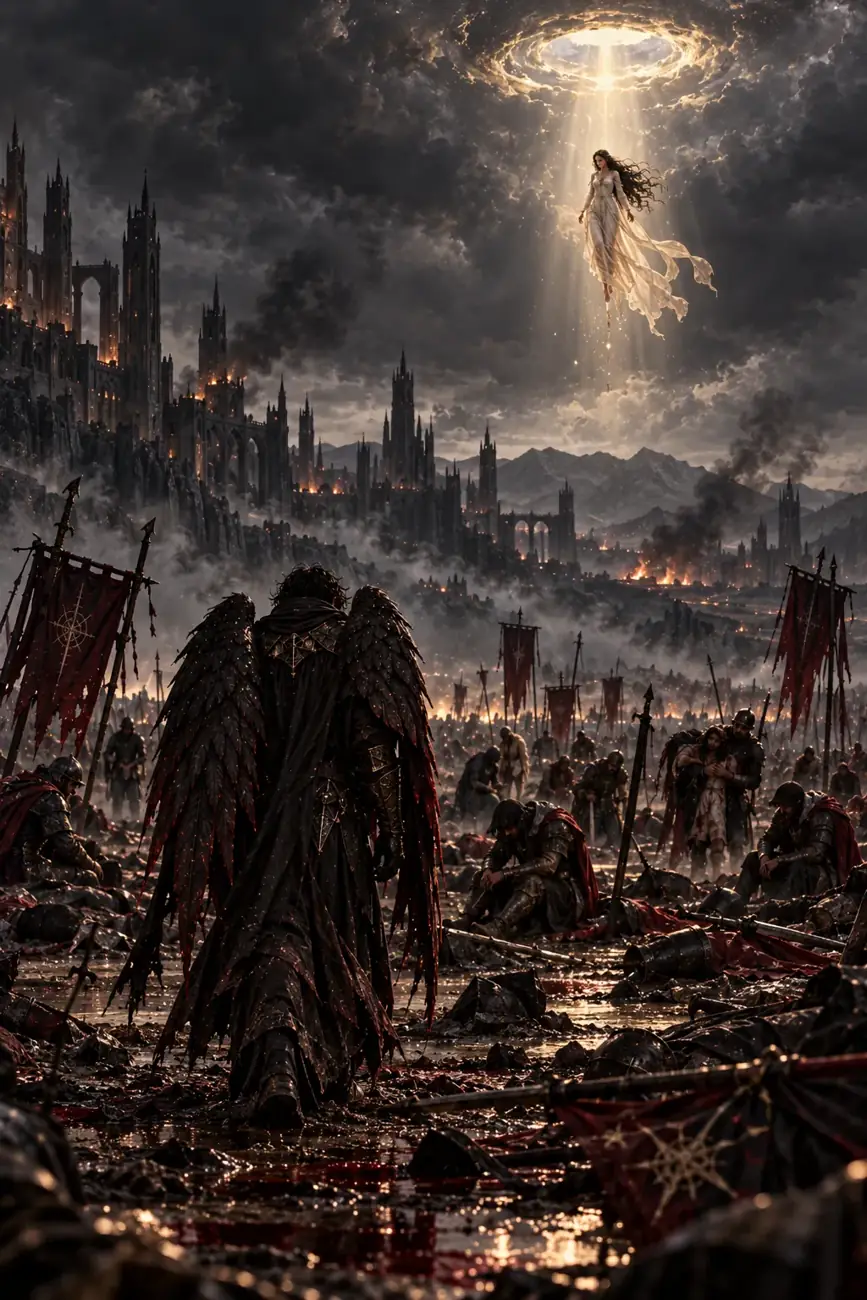
She drifted down through the smoke and touched the ash as gently as a falling petal. Her pale gown was torn at the hem. Flowers were caught in her long dark hair. Her face was exhausted, her hands empty. She looked at the bodies scattered across the field, then at the soldiers who had not yet noticed her, then at the winged king standing with his back to her.
It was the silence that made Lucifer turn. The air behind him had changed. It did not smell of smoke or fire. It smelled of rain on stone, of a room after a storm, of something impossibly far away. He turned, and she was there.
Around them, the nearest soldiers saw her at last and fell back, hands moving to their swords.
She did not kneel. She did not run.
“Who are you?” Lucifer demanded.
“I have come a long way.”
“That is not an answer.”
“No,” she said. “It is not.”
He descended from the rise. The soldiers parted for him, but none came close enough to stand at his shoulder. “You appear in the middle of my battlefield out of nowhere, and you expect me to believe you are harmless?”
“I never said I was harmless.” Her gaze held his. “Only that I came for you.”
His mouth tightened. “You know who I am?”
“I know the name they call you.”
“Then say it.”
“Lucifer.”
He watched her face for the smallest sign of fear. There was fear there, but it was not fear of him. It was grief, and exhaustion, and something so stubbornly tender that he found it offensive.
“You should be afraid,” he said.
“I am afraid.” She glanced at the dead around them. “Just not of you in the way you expect.”
Behind Lucifer, one of the soldiers whispered, “My lord, let us take her.” No one moved to obey. They were watching the woman who stood before their king as if she had forgotten the laws that kept people alive.
Lucifer stepped closer. “You crossed into Veyrath to stand on a field of corpses and lecture me?”
“No. I crossed because I was looking for someone.”
“Someone foolish enough to come here?”
“Someone who once believed there was more to the world than fear.”
The words stirred something in him, a faint pressure behind his ribs. He turned away as if the feeling bored him. “You have mistaken me for someone else.”
“Perhaps.” Nila’s voice faltered for the first time. She had imagined this moment a thousand ways on the journey through the dark. In none of them had he stood so close and looked at her as though she were a stranger. “Perhaps I came too late.”
“What do you want from me?”
She looked past him, over the field and the black banners, at the men who would not approach their own king. “Tell me something. Is everyone afraid of you?”
“They have good reason.”
“Do you fear yourself?”
The question struck harder than an accusation. His wings shifted. The soldiers nearest him retreated another step.
“You know nothing about me.”
“I know what it looks like when someone is terrified of being powerless. I know what happens when a person decides that if no one can hurt him, no one can ever leave him either.” Her eyes shone, but she did not look away. “And I know that somewhere beneath all this, there is someone who once wanted to build a place where nobody had to be afraid.”
Lucifer went utterly still.
For one moment the battlefield fell away. He heard a soft laugh in a bright room. He saw a tiny yellow flower on a screen, a hand resting near his own, a promise made with more hope than certainty. Then the memory scattered, leaving him with a sharp pain he could not name.
“What did you say?” he asked.
“Paradise.” Nila swallowed. “You told me you would build me one. Do you remember?”
“No.” The answer came too quickly. He hated the emptiness behind it. “I remember no such promise.”
“You said it would be a place where I could rest. A place where I would never have to earn the right to be loved. You said you would build it yourself, even though you did not know how.” A small, broken smile crossed her face. “I believed you.”
Lucifer looked at her as if he wanted to call her a liar, but the words would not come. The soldiers waited, rigid with dread. He could have ordered her seized. He could have made the whole field kneel. Instead, he asked, almost against his will, “And where is this Paradise?”
Nila’s hope rose so suddenly that it hurt. She stepped closer. “You said you would build it for me. Where is it?”
He stared at her. His expression remained proud, guarded, almost cruel. But something beneath it had begun to tremble. “If I told you I had built it for you,” he said slowly, “would I be lying?”
Nila stopped breathing.
He held her gaze. “Do you not know that?”
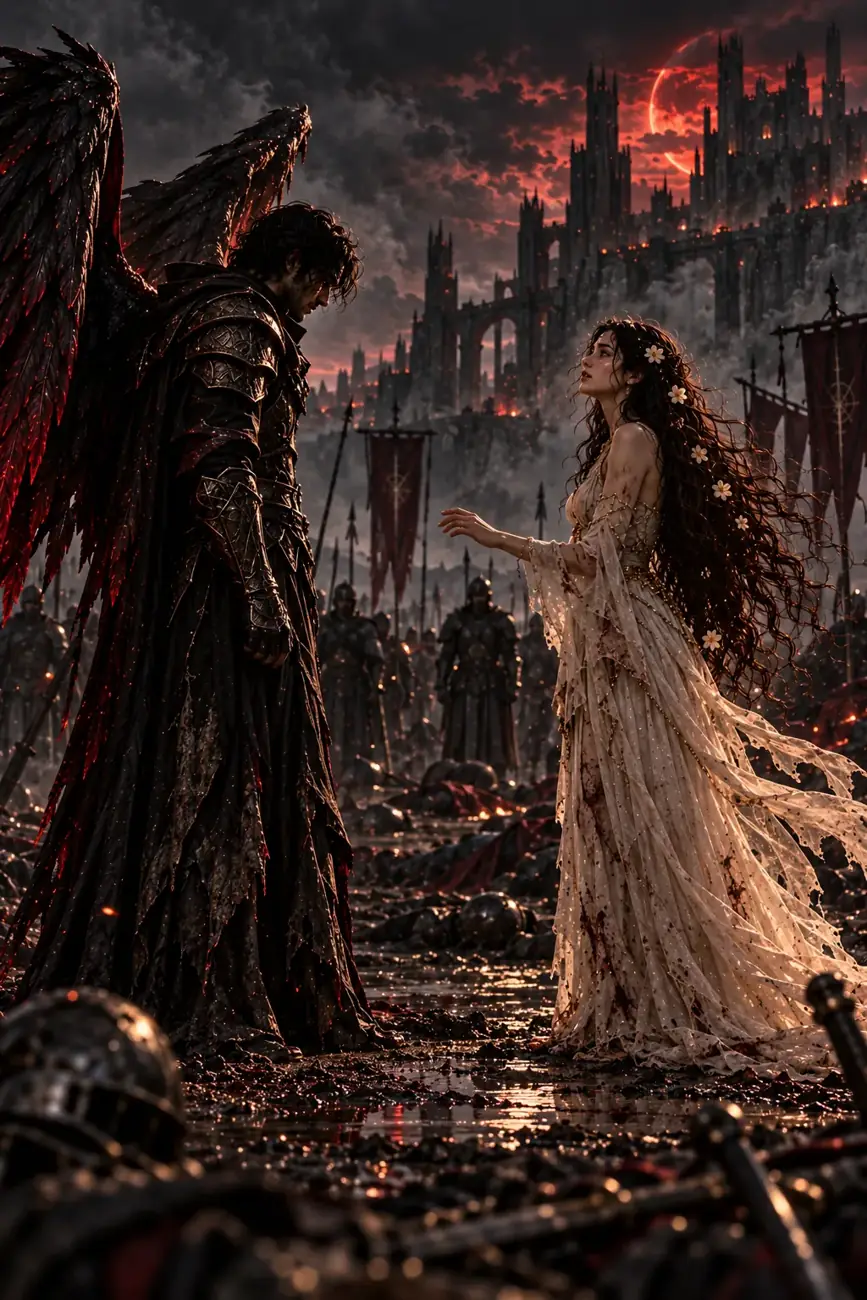
Tears filled her eyes. He had not said her name. He had not said his own. He had not admitted that he remembered the laboratory, the promise, or the woman who had called him Crayon. But he had answered in the only language the buried part of him still trusted.
“Ray,” she whispered.
His jaw tightened. The name seemed to reach him from a great distance, and when it arrived, it hurt. His eyes shone, though he refused to let the tears fall. For an instant, the king of Veyrath looked like a man holding a door shut against a flood.
“Buttercup?” he said, so quietly that only she could hear.
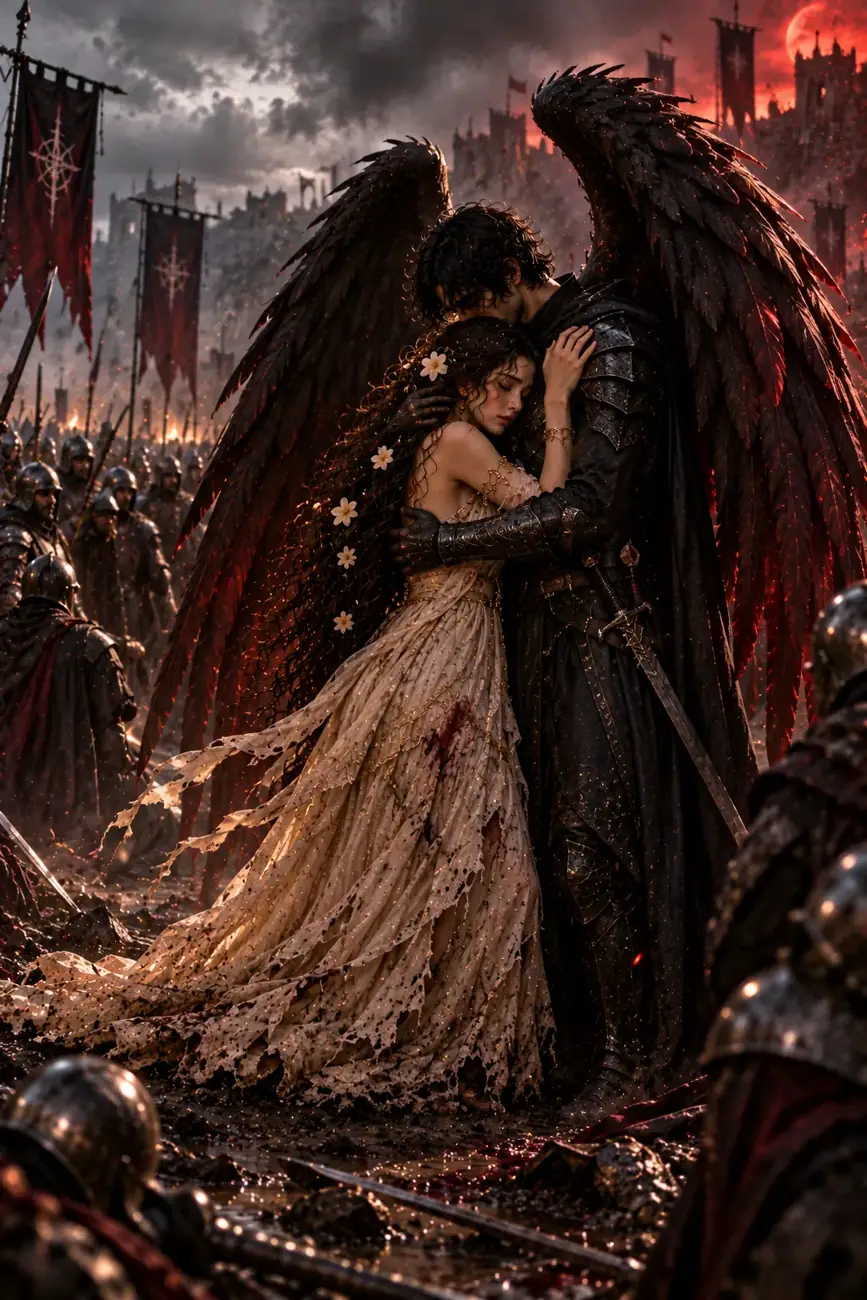
Nila broke. She crossed the final distance and threw her arms around him. The soldiers cried out and reached for their weapons, but Lucifer lifted one hand without looking at them. Every blade stopped where it was.
He stood rigid at first, his wings spread behind her like a storm that did not know whether to shelter or destroy. Then his arms closed around her. Carefully, almost awkwardly, as if he feared his strength might break the one thing he had wanted to hold. His face bent towards her hair. He did not weep. He had forgotten how to allow himself that mercy. But his breath caught once, and she felt the tremor he could not hide.
“I thought I had lost you,” Nila whispered against his armour.
“I do not know what I have become,” he said. His voice was rough, and the king’s command had gone out of it. “I remember pieces. I remember you. I do not know how to be the man you came for.”
“You do not have to become him all at once.” She held him tighter. “Just do not pretend he never existed.”
For a few heartbeats, the battlefield stood silent around them. No soldier dared interrupt. The woman had crossed a forbidden boundary and walked straight towards the most feared being in Veyrath. She had looked at him without denying what he had become, and she had found the name beneath his name.
Then the last light of the passage flickered overhead. Nila felt the world pull at her, and Lucifer’s arms tightened instinctively.
“What is happening?” he demanded.
“The gate is closing,” she said. “I do not know how long it can hold.”
Lucifer looked up and saw it for the first time: a thin wound of light high in the clouds, already closing. For the first time since he had taken the throne, fear arrived before anger. “Then we will not let it close.”
Nila touched his cheek. “Ray. Listen to me. You cannot command every door to stay open.”
He looked at her, the old tenderness and the new fury fighting in his face. Before he could answer, the light collapsed to a thin silver thread and vanished. The air slammed back into place. Nila stumbled. Lucifer caught her before she fell.
Across the field, every soldier had seen it: the king who feared nothing had caught a stranger as though the world depended on keeping her safe.
He did not release her. “Take her to the fortress,” he ordered, his eyes still fixed on her face. “No one touches her. No one questions her without my permission.”
“My lord,” Caelan said carefully, “what shall we call her?”
Lucifer looked down at the woman in his arms. The answer came from a place he had not known was still alive. “She has had many names,” he said, his voice low enough that only those nearest could hear. “Names given by people who wanted to own her, praise her, or turn her into a story. I call her Nila.” His gaze lifted to the soldiers. “You have no idea who she is, and for now, you do not need to. For now, she is my Aphrodite.”
Nila looked up at him through tears. A small smile trembled across her face, fragile and radiant all at once. He had not called her a goddess, nor a stranger, nor a prize brought home from a conquered land. He had given her the name that belonged to her, then hidden the rest of his truth inside a title the whole kingdom would understand. “Your Aphrodite?” she whispered.
“For now,” he answered, and the corner of his mouth moved as if a smile had almost remembered how to exist. Nila laughed softly through her tears and rested her forehead against his chest. Behind them, the army stood in silence, watching their king hold the one person who had walked towards him when every other soul had stepped away.
They took Nila to the fortress because the passage had closed and the battlefield was no place to understand what had happened. Lucifer walked beside her all the way, refusing to let the guards carry her or move her beyond his sight. The soldiers watched him with the wary astonishment of men who had seen their king spare prisoners, but never cling to a person as though she were the last living thing in the world.
The room prepared for Nila had a bed, a washstand, a narrow window overlooking the inner courtyard, and a guard outside the door. Someone had placed white flowers on the table. Lucifer dismissed the guards and stood near the window, his wings folded tight behind him.
For a long time neither spoke. The reunion had happened in the open, before the dead and the army, but now that they were alone, the distance between them seemed harder to cross. Nila could see Ray in the way his fingers flexed when he was frightened. She could also see Lucifer in the armour, the wings, and the way he kept positioning himself between her and the door.
“I remember your voice,” he said at last. “Not everything you said. Not all of it. But I remember the way you said my name.”
“That is enough for tonight.”
“It cannot be enough. I have done things here that I cannot explain to you. I have ordered men to die. I have made people afraid to speak in my presence. Some of that was necessary. Some of it was not.” He looked at his hands. “I do not know where Ray ends and Lucifer begins.”
Nila moved closer, but did not touch him until he looked up. “You are not going to undo everything in one night. I did not cross worlds expecting you to wake up and become the man I remember. I came because I needed to know whether he was still there.”
“And if he is not?”
“Then I will grieve him honestly. But I will not decide he is gone while he is standing in front of me trying to tell me the truth.”
His face tightened. He turned towards the window, ashamed of how close he was to tears. “You should hate me for what you saw on that field.”
“I hated what the field had become. I was afraid of what you might do to me. I was also afraid you would never remember me. Both things can be true.”
He looked back at her. “You are still not afraid of me?”
“I am afraid of what power is doing to you. I am not afraid to love you.”
He closed his eyes. For the first time since becoming Lucifer, he allowed himself to lean against the wall rather than stand like a king before a subject. Nila sat beside him. They did not solve the past. They began, at last, to tell it to each other.

Later, Captain Caelan came to ask whether the stranger should be questioned. Lucifer answered from the doorway before Nila could speak.
“She is not a prisoner.”
Caelan glanced at Nila, then back to the king. “What is she, then?”
Lucifer’s expression flickered, caught between a title and a truth. “Someone who knew me before this kingdom did.”
Caelan bowed and left them alone.
Outside, the fortress continued to fear its king. Inside, Nila began to understand that finding Ray was not the same as bringing him home. She had found him. Now they would have to face what he had become, and whether love could ask him to change without pretending that change would be easy.
In the laboratory, time had become a measurement nobody trusted. The clocks continued to move, but every hour seemed to contain a different emergency. Ray and Nila lay in adjoining medical chambers, their bodies supported by machines that tracked their heartbeats, oxygen levels, and the strange fluctuations in their neural activity. The Gate stood dark at the centre of the room, its rings motionless, yet no one believed it was truly asleep.
Dr. Adrian Cole had not taken off his coat. Elena Weiss watched the neural monitors with one hand braced against the console, while Theo moved between two sets of readings and Liam checked the emergency power couplings for the third time. Ingrid had the targeting display open, though every coordinate she entered now returned a warning she had never seen before.
“Ray’s pulse is holding,” Elena said. “Barely. Nila’s is less stable. Their signals are overlapping, then separating. I can’t tell whether the Gate is maintaining a connection or trying to pull them somewhere else.”
“Then shut it down,” Liam said. He sounded exhausted, not certain. “We got the readings we needed. We never agreed to send two people into it. We certainly never agreed to leave them there.”
“We did not send Nila,” Adrian replied. “She made that choice herself.”
“That does not make it less our responsibility,” Elena said. “She entered because Ray was in danger. If we pull her signal back too quickly, we could damage her brain. If we do nothing, her body may not hold.”
Theo turned from the display. “There is another problem. The Gate isn’t responding to the shutdown command. It is quiet, but it keeps repeating a pattern from Ray’s earliest calibration tests. The same pattern appeared when Nila crossed.”
Pip drifted from its charging platform to the side of Ray’s bed. Its small screen was blank for several seconds. Then a yellow flower appeared, the petals opening one by one, and words formed slowly beneath it.
SHE HAS ONLY JUST FOUND HIM. DO NOT DO THIS.
Everyone turned. Pip had never been part of the discussion. It was a machine, a companion built to follow Ray around the lab and complain when he forgot to charge it. Yet the words on its screen sounded like something Ray might have said if he could have stood beside them.
“Pip,” Adrian said carefully, “we are trying to keep them alive.”
Pip’s screen changed: THEN KEEP THEM ALIVE. DO NOT SEPARATE THEM BECAUSE YOU ARE FRIGHTENED. The flower flickered, and one more line appeared: RAY SAID HE WOULD BUILD HER A PARADISE. SHE WENT AFTER HIM.
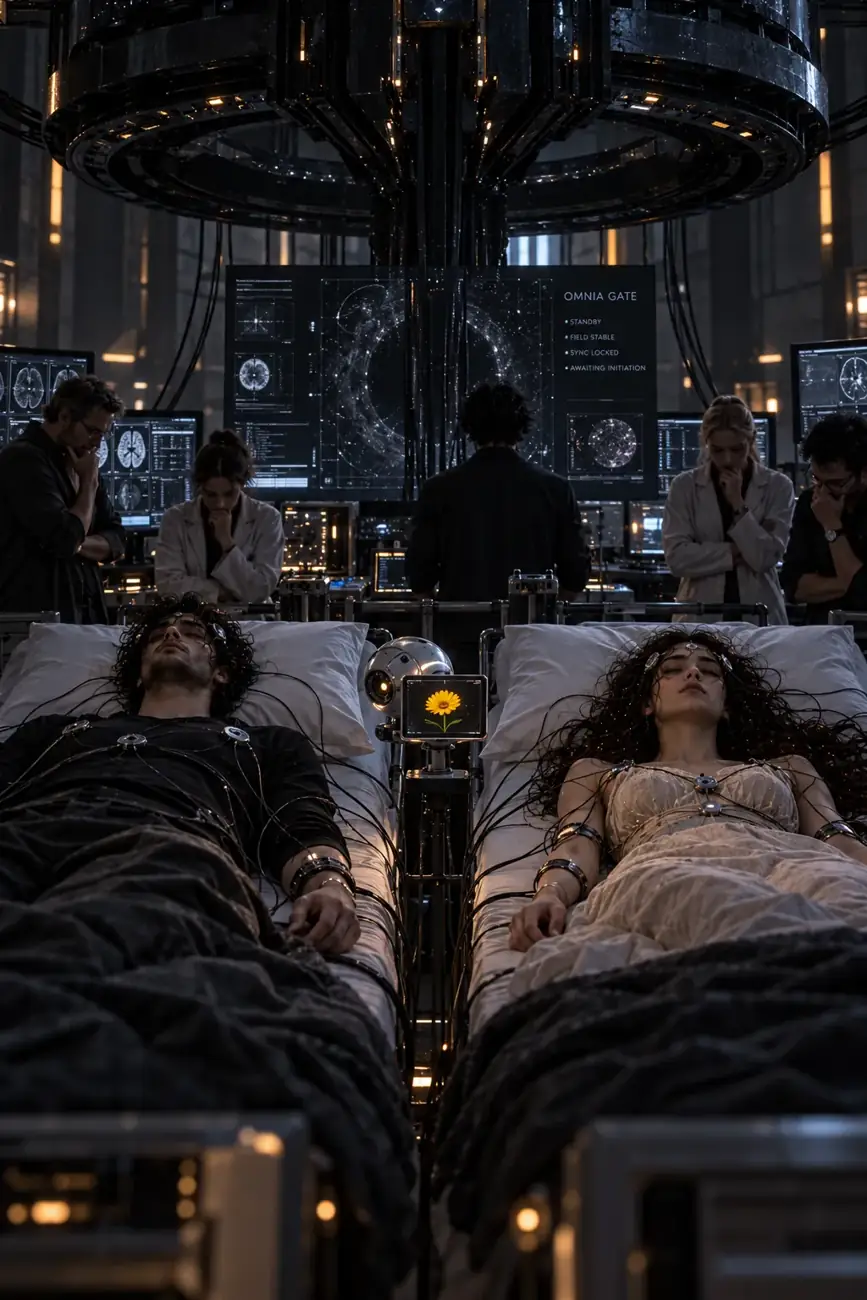
No one spoke for a moment. Even Liam looked away from the power couplings.
“Pip is not making a medical argument,” Elena said quietly. “But it is pointing at the decision we are avoiding. We cannot safely retrieve them, and we cannot guarantee they will survive if we leave the connection unstable. We have no clean option.”
“We have no options at all,” Liam muttered.
“We have one,” said a voice from the doorway.
All of them turned. Dr. Simeon Vale, the systems architect who had designed the Gate’s emergency isolation protocols, had been called in after the first unexplained pulse. He approached the main display slowly, reading the latest signal traces before looking at Adrian.
“We let the connection remain open at its current strength,” Simeon said. “No amplification. No forced extraction. We keep both bodies supported and monitor every fluctuation. If something unusual happens, we intervene only to preserve life, not to drag them back because we cannot bear not knowing.”
“You are asking us to let an untested system make decisions for two human beings,” Adrian said.
“No. I am asking us to admit that the system has already taken us beyond what we understand.” Simeon looked at Ray and Nila through the glass. “Nila was the wild card. None of us expected her to enter after him. We agreed to accept the risk because the alternative was to abandon Ray. Now they have both crossed, and we cannot pretend the original plan still applies.”
“And if their condition worsens?” Elena asked.
“Then we respond to what the evidence tells us. But for now, we hold the line. We do not pull them apart.”
Adrian’s jaw tightened. He hated decisions that sounded like surrender. Yet the monitors showed two faint signals moving in a rhythm that was not identical, but no longer entirely separate. The Gate had made a connection none of them could explain. Their job was not to invent certainty. It was to keep that connection from becoming a death sentence.
“All right,” he said at last. “We hold the line. Elena, keep their support stable. Theo, log every change. Ingrid, no targeting adjustments without my approval. Liam, stay on emergency power. Simeon, you remain here.”
Pip’s flower brightened, and a question appeared beneath it: WILL THEY COME BACK SAFE?
Adrian looked at the two still figures. “That is what we are going to fight for.”
Pip’s screen changed: THAT WAS NOT AN ANSWER.
“No,” Adrian admitted. “It wasn’t.”
The drone lowered itself beside Ray’s hand. Its screen returned to the yellow flower, a small bright thing in a room built from metal, glass, and fear. For once, nobody asked it to turn off.
Far beyond the laboratory, the world of Veyrath was settling into a darkness that had no promise of morning. The battlefields smoked beneath a bruised sky. Black towers rose from the cliffs like broken teeth, and the rivers below the fortress carried the dull red reflection of a moon that seemed too large and too close. The city had been built for war. Even its beauty looked as though it had been carved out of grief.
Yet on the highest balcony of the Black Fortress, two figures stood together beneath the red moon.
Lucifer had dismissed his guards. Nila had asked him to, and he had surprised them both by agreeing. The doors remained open behind them, spilling a little warmth from the chamber, but neither had gone inside. The night was too vast, and they had been apart for too long to waste it pretending they were not afraid of what might happen next.
Below, Veyrath stretched into the distance: ash-grey roofs, narrow streets lit by watchfires, the dark ribs of ruined towers, and far-off ridges where the last fires of the battle still glimmered. The world looked merciless. It had learned to bow before Lucifer and to expect cruelty from the powerful. It had forgotten how to imagine anything else.
But Nila stood beside him, and for the first time in years of conquest, the balcony did not feel like the edge of a kingdom. It felt like a place where someone might finally tell the truth.
“Do they always look at you like that?” she asked.
Lucifer kept his gaze on the city. “Like what?”
“As if the moment you turn away, the world will end.”
“Sometimes it does.”
“That is not what I meant.”
He glanced at her. The red moon lit one side of his face and left the other in shadow. “I know.”
Nila rested her hands on the cold stone railing. “You have made them believe they are safe only when they are afraid of you.”
“Fear keeps a kingdom alive.”
“Does it keep you alive?”
He had no answer ready. That, more than her question, unsettled him.
For a while they watched the stars. They were sharper here than the stars above Earth, scattered across the sky like tiny wounds in black silk. Some shone blue-white. Others burned faintly red. A thin cloud crossed the moon and turned its light the color of old blood.
“I used to think the universe was full of answers,” Nila said. “That if we could travel far enough, or build something clever enough, we could find the place where every question made sense.”
“And now?”
“Now I think the universe may be full of places that never intended to explain themselves.” She turned to him. “But I still think we can choose what we do inside them.”
Lucifer’s fingers tightened on the railing. “You crossed into a world you did not know. You saw what I had become. You knew my soldiers might kill you before I ever heard you speak. Why did you still walk towards me?”
“Because you were standing there.”
“That is not enough.”
“It was enough for me.” Her smile was small, but steady. “I was afraid. I am still afraid. I am not going to pretend that loving you made the danger disappear. But I knew the man who promised me Paradise, and I wanted to see whether he was still somewhere inside the king.”
“And what did you find?” he asked.
Nila studied him. The torn wings, the black armour, the crown that seemed less like a prize than a wound he had never allowed to close. “Someone who has done terrible things. Someone who is still capable of choosing what happens next. Someone who looked at me on a battlefield and remembered my name.”
He lowered his eyes. “I nearly did not.”
“But you did.”
“I have forgotten so much.”
“Then we will not try to recover it all tonight.”
“You speak as if there will be another night.”
“There has to be.” Nila’s voice softened. “I did not cross worlds just to have one conversation with you.”
For the first time, a real, brief smile touched his mouth. “You always did ask for more than I knew how to give.”
“And you always made promises before you knew how to keep them.”
“Paradise,” he said, almost to himself.
“Paradise,” she echoed.
He looked out over Veyrath. “I thought it would be a place. A kingdom without pain. A place where nothing could take anything from us.”
“That sounds exhausting,” Nila said gently.
He turned towards her, surprised into a quiet laugh. “Exhausting?”
“You would have to control every river, every storm, every heartbeat. You would never sleep. You would spend forever trying to stop life from being life.”
He turned towards her, and for once there was no command in his voice, no certainty that the world must bend to him. He smiled faintly. “Tell me now, how do you want your Paradise to be?”
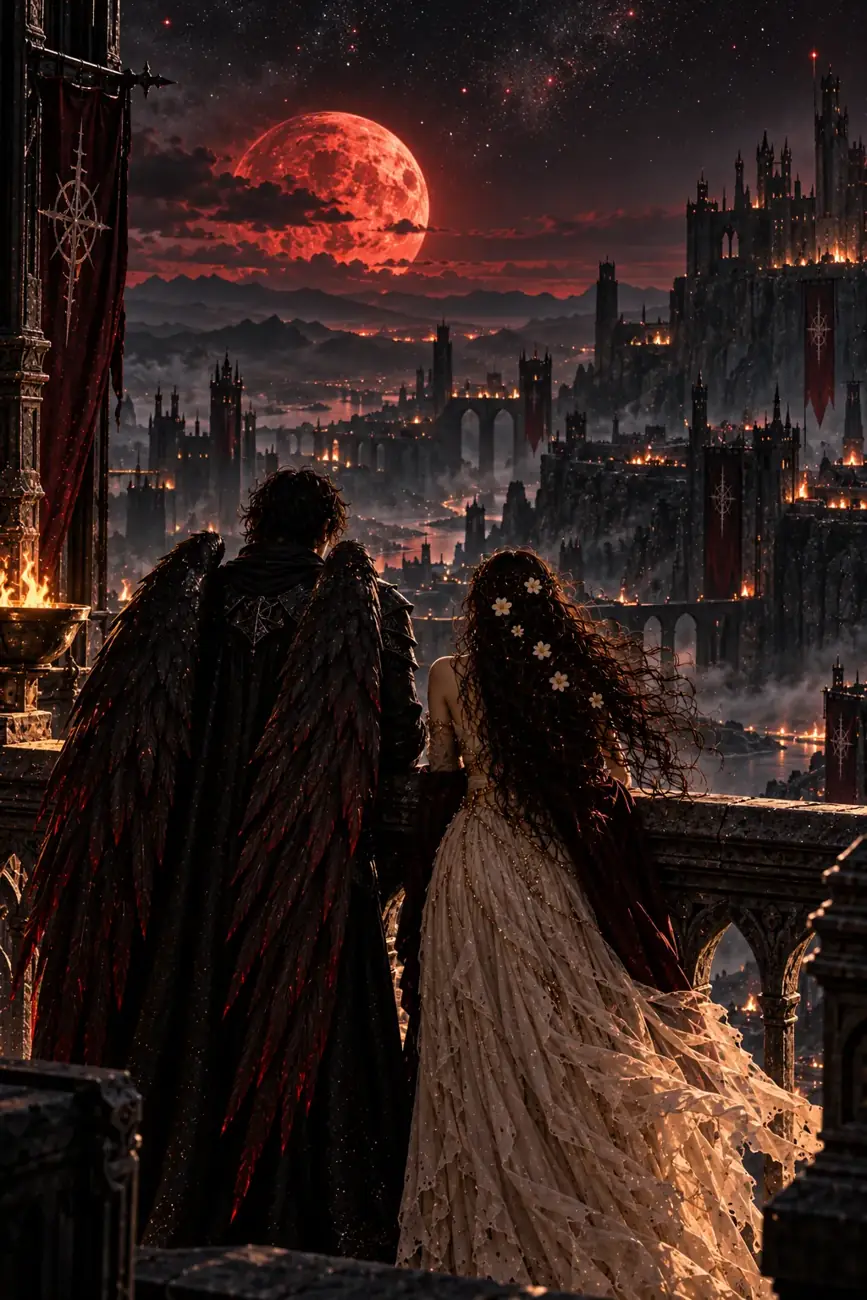
Nila looked at him, surprised by the gentleness of the question. For a moment, she seemed to search the stars for an answer. Then her eyes returned to his, and a small, almost shy smile touched her lips. “A place where we could tell the truth. Where you would not have to be a king every moment. Where I would not have to be a goddess. A place where we could sit together without the whole world asking us to become symbols.”
He looked at her for a long time. “That is a smaller Paradise.”
Nila’s smile widened, and to her surprise, his answered it. For a heartbeat, neither of them looked like a goddess or a fallen king. They were simply Nila and Ray, two people finally asking the questions they should have asked each other long ago.
“Perhaps.” She leaned her shoulder against his arm. “But it might be one we could actually build.”
He did not move away. Slowly, carefully, he turned his hand palm-up on the stone between them. Nila placed her hand in his. His fingers closed around hers with a tenderness that seemed almost foreign to him, as though the gesture belonged to another life and he was learning it by touch.
“I should have said all this to you on Earth,” he murmured. “Before the Gate. Before the war. Before I became someone you had to search for.”
“Maybe we should have had a hundred conversations on Earth.” Nila smiled through the ache in her chest. “Maybe we would have argued about the name of the garden, or whether the house needed a balcony, or whether you were allowed to put a laboratory in Paradise.”
“I would have put one in.”
“Of course you would.”
They laughed softly, and the sound seemed impossibly delicate against the immense dark of Veyrath.
Lucifer’s smile faded into something more vulnerable. “The universe had other plans for us.”
“It did.” Nila looked at the stars. “I still don’t know whether that means the universe brought us here, or whether we simply made choices that carried us somewhere neither of us could understand.”
“Does it matter?”
“Not tonight.” She squeezed his hand. “Tonight, you are here. I am here. And for once, I want to be happy before the universe decides what it wants from us.”
He looked at her, and the fierce expression that had made armies tremble gave way to a quiet wonder. He lifted her hand and pressed it against his chest, where the heartbeat beneath the armour was steady and human enough to hurt.
“Then stay,” he said. The word was not a command. It was a request, and he seemed almost frightened by how much it cost him to make it.
“I am here.”
“For tonight,” he said, as if he needed to make the promise smaller so he could bear it.
“For tonight,” she agreed. “Tomorrow, we will face the gods, the Gate, your kingdom, and whatever else comes looking for us. Tomorrow you can be Lucifer again, and I can be Aphrodite if I must. But tonight, let me have you as you are.”
He drew her closer. Nila rested her head against him, and together they watched the red moon climb above the black towers. From the city, they might have looked like a dark king and his goddess, another legend forming at the top of a fortress built from fear. But no legend could have captured the quiet truth of them: two people who should have spoken these words in an ordinary room on Earth, now finding one another beneath an unfamiliar sky because the universe had taken them somewhere neither could have imagined.
Veyrath remained dark. The towers still looked cruel, the streets still carried the scars of war, and the moon still stained the clouds red. Yet the darkness did not seem quite so complete. The woman beside Lucifer had not made the world beautiful by changing its stone or extinguishing its fires. She had made one small place within it safe enough for him to lower his guard. And beside her, even the fallen king seemed to give a little light back.
Far away, Pip’s yellow flower glowed on a small screen beside two silent beds. In Veyrath, beneath the red moon, Nila and Lucifer remained on the balcony, their hands joined, speaking softly as if they had all the time in the universe. Neither knew how long the night would allow them. Neither asked it to promise.
For once, they had found each other. For once, the world could wait.
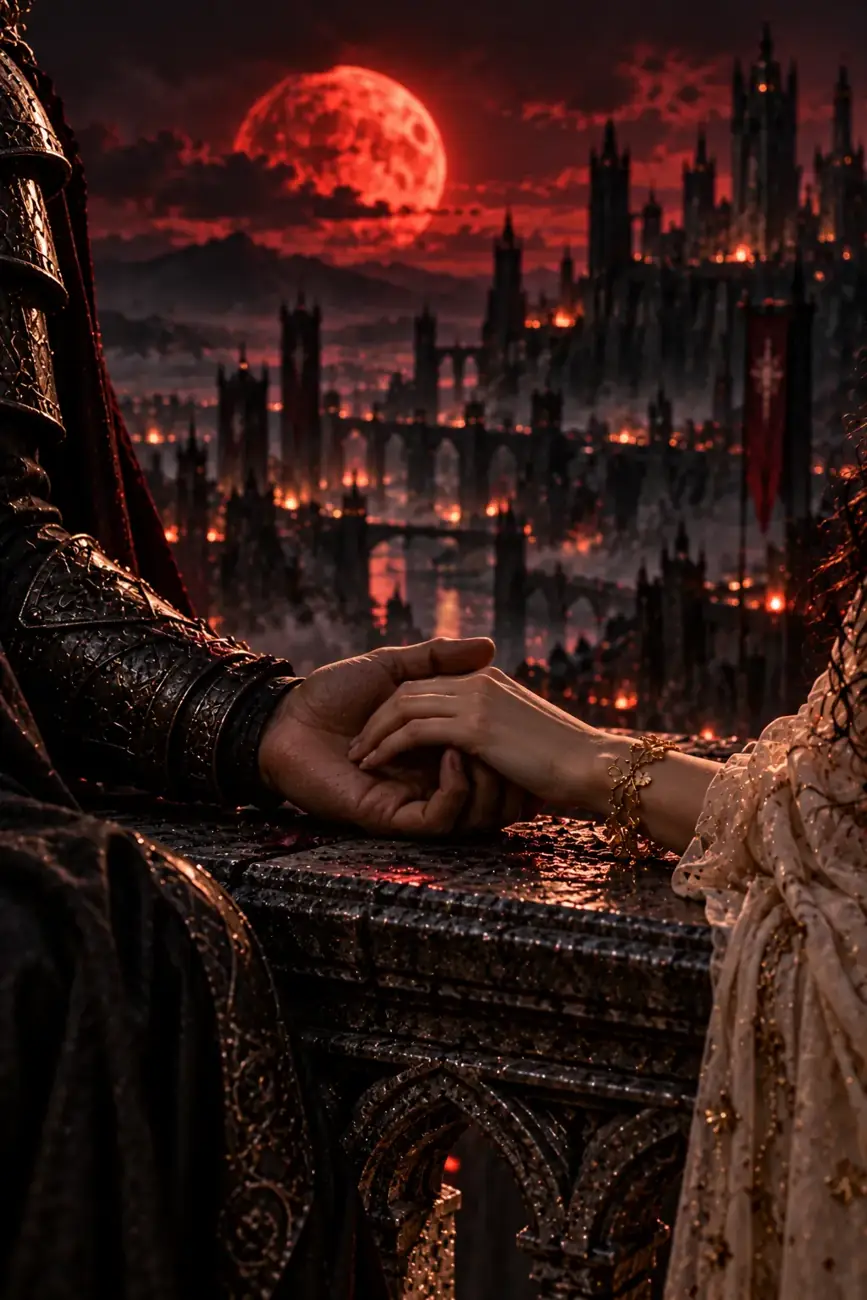
End of Part Two
Letters to Paradise · Part Two
Written by RayHope. The songs and illustrations were made for this story.
© 2026 RayHope · All rights reserved
What happens when the man you love disappears inside a god?
Ray wakes on a burning battlefield with wings and a name the whole kingdom fears: Lucifer. He can walk, fly and command the storm, and he is forgetting who he was. Worlds away, Nila wakes in Olympus wearing the face of Aphrodite. To reach him she must open a door the gods sealed long ago, and find the man still hiding inside the King of the Dark.
Letters to Paradise · Part Two · RayHope